# 998
Pandemic drills are fairly common, and not terribly newsworthy. This small notice in the The Birmingham News today caught my eye for a couple of reasons.

 Scott McPherson
in Politics and government, influenza and infectious diseases
|
Scott McPherson
in Politics and government, influenza and infectious diseases
|
 Post a Comment
 Yet again, a mighty tip of the cap to the intrepid blogger at birdflunewsflash.com, a site living up to its domain name. The site reports that the government of Bali has decided to call in the spin doctors and will filter all news regarding human and bird H5N1 infections.
The link to the blog is here, http://birdflunewsflash.wordpress.com/2007/08/29/bali-to-censor-news-about-the-current-bird-flu-outbreak/
and the link to the Jakarta Post story is here. Could we put these intrepid Jakarta Post staff writers up for a global Pulitzer? http://www.thejakartapost.com/detailbali.asp?fileid=20070829.D08&irec=1
Now back to the analysis.
It seems Bali is taking the Mayor Larry Vaughn approach to their new bird flu situation. That, of course, is to ignore the problem and try to spin its way out of it. Let me pull some quotable quotes from the story.
The administration's spokesperson, Anak Agung Bagus Netra, on Tuesday said Governor Dewa Beratha had ordered all information regarding bird flu be delivered only by the public relations department.
"We are talking about a new outbreak here. We can't have (ill-informed) people speaking about it on behalf of the administration. This is about Bali's image. These days any information can fly overseas in a second," he told The Jakarta Post.
OK, so the spin doctors have now used the word outbreak. I don't know if we would consider the Bali cases/deaths an outbreak just yet, but the Bali government seems perfectly content to accelerate the danger themselves. You've got ill-informed people speaking for the government now. Reading on:
Farmers are questioning new poultry regulations issued by the administration in an effort to eradicate H5N1 from the province. Bali deputy governor Alit Kesuma Kelakan last Sunday hinted at the idea of culling all fowl on the island, without elaborating on compensation for farmers.
Meanwhile, Udayana University virologist Ngurah Mahardika suggested that tourist destinations such as Kuta, Sanur and Nusa Dua be free from fowl, following the rapid spread of bird flu virus on the island.
"This is a better move than simply taking chicken off menus," Ngurah told the Post over the weekend.
The de-fowling of Bali will place local farmers directly at odds with tourist officials, hoteliers and restaurateurs. Killing poultry without compensation is a prime factor in the re-emergence of H5N1 in flocks, according to multiple sources all over the planet. Witness the laughable escapade in Egypt just last year, where farmers successfully and clandestinely moved a thousand chickens across town under the noses of Egyptian government cullers. What Woody Allen or Mel Brooks could have done with that scene! So Bali civic leaders had better pony up the money for the soon-to-be-dead chickens and ducks.
Ngurah said the human-fowl population density in Bali, especially in Denpasar, made the region prone to a bird flu outbreak. Lagging precautionary measures, Ngurah said, could help the virus spread and develop more quickly, thereby increasing the threat of a pandemic on the island.
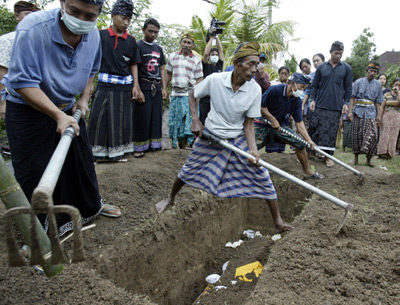 By my count as of 4PM EDT on the 29th of August, a total of 11 people have been hospitalized with suspected H5N1 infections on Bali. Four have died, and five have been released. Two remain in hospital -- admitted in the past 48 hours. Two of the four deaths are absolutely H5N1, and the index case -- the daughter of one of the dead -- died and was cremated before tests were able to be conducted. It is strongly assumed she was infected with H5N1 and gave the virus to her 29 year-old mother, who in turn died and was buried (photo at left). The fourth death is still to be resolved. Whether or not the world gets the truth may be up to the Indonesian Health Minister, and we already know which side she is on.
Additionally, thousands of poultry are being culled as we speak, as the Bali fathers desperately try to salvage their tourist season. I certainly hope a secondary vector has not been established on the island yet. Perhaps Bali should swab the throats of their housecats, too.
Dr. Henry Niman frequently utters an excellent quote: "H5N1 does not read press releases." Never has this been more appropriate than with this latest complication from Bali.
Scott McPherson
in Politics and government, influenza and infectious diseases
|
5 Comments
|
 2 References
 Current HHS Assistant Secretary for Health, Dr. John Agwunobi, has resigned to accept an appointment with Wal-Mart Corporation. This move should not really come as a surprise, as Washington insider speculation had Agwunobi pegged early on as a contender for the position of Surgeon General. When President Bush decided to appoint another individual to serve in that position, Agwunobi realized his political and government service careers had, at least temporarily, reached their zenith.
What is not in the press (and one of the reasons why you hopefully read and subscribe to this blog) is the Rest of the Story on the Wal-Mart move. The individual who recruited Agwunobi to the Bentonville, Arkansas megacorp is none other than Bill Simon. Bill is former Secretary of the Department of Management Services under former Governor Jeb Bush, and served as Secretary while Agwunobi served as Florida's Secretary of Health. Simon left State government, in no small part, because of radiation poisoning from the still-radioactive PeopleFirst debacle. Simon had nothing to do with that project, except try in vain to repair it and make it workable. When it became apparent his legacy as Secretary would revolve around that unstable radioactive mass, he wisely left and cashed in at the House That Sam Built.
Ditto Agwunobi. Here are the HHS and Wal-Mart press releases, in full. I also wanted to give a hat-tip to the "reveres" at flu blogsite Effect Measure for breaking the story.
For Immediate Release Contact: HHS Press Office
August 7, 2007 202/690-6343
STATEMENT FROM HHS SECRETARY MIKE LEAVITT ON THE RESIGNATION OF ASSISTANT SECRETARY FOR HEALTH DR. JOHN AGWUNOBI
I regret to announce the resignation of Dr. John Agwunobi as Assistant Secretary for Health (ASH) and an Admiral in the US Public Health Service (USPHS) Commissioned Corps effective September 4th, 2007.
Since joining HHS in 2005, Dr. Agwunobi has been a passionate voice for advancing the health care of all Americans. His leadership, counsel and expertise have contributed greatly to increasing American's awareness and preparedness for pandemic influenza, encouraging adoption of healthier lifestyles and leading the renewal of the USPHS Commissioned Corps.
Dr. Agwunobi has distinguished himself through the energy and commitment with which he has approached every task at HHS. I will miss him personally and professionally and wish him well in his future endeavors.
FOR IMMEDIATE RELEASE Contact: Sarah Clark, Wal-Mart1-800-331-0085
Dr. John Agwunobi to join Wal-Mart as Senior Vice President and President for the Professional Services Division
BENTONVILLE, Ark., Tuesday, August 7, 2007 --Wal-Mart Stores, Inc. is pleased to announce that Dr. John Agwunobi, current Assistant Secretary for Health for the U.S. Department of Health and Human Services and an Admiral in the U.S. Public Health Service Commissioned Corps, has been named Senior Vice President and President for the Professional Services Division for Wal-Mart in the U.S. effective September 4.
Dr. Agwunobi will oversee the company's health and wellness business unit including pharmacies, vision centers and health care clinics. He is the country's expert on public health, and he will bring new perspective, diverse talents and tremendous expertise to our company in his new role.
He will report to Bill Simon, executive vice president and chief operating officer for Wal-Mart Stores U.S.
"John is the country's expert on public health, and I look forward to his contributions in furthering Wal-Mart's health and wellness efforts," said Simon. "He will bring new perspective, diverse talents and tremendous expertise to our company in his new role."
Added Dr. Agwunobi, "Wal-Mart touches many lives in many communities and this position provides me with a new opportunity to reach people in the places where they live, work and shop. I am very excited to join the Wal-Mart team."
Dr. Agwunobi, also a pediatrician, is a seasoned public health professional with experience in health care delivery, managed care and health care policy. As Assistant Secretary for Health, he was responsible for disease prevention, health promotion, women and minority health efforts, the reduction of health disparities, the fight against HIV/AIDS, pandemic influenza planning and vaccine preventable disease initiatives.
Prior to his current position, Dr. Agwunobi served as Florida's Secretary of Health and State Health Officer from October 2001 to September 2005. In this role, he confronted many public health challenges, including leading the state's public health and medical response to four major hurricanes, led the call for a healthier Florida, managed the response to the nation's first-ever intentional anthrax attack, and guided Florida's nationally-recognized efforts to protect the state against bioterrorism.
Scott McPherson
in Politics and government, influenza and infectious diseases
|
Post a Comment
 The Department of Justice is not taking pandemic concerns lightly. In fact, the DoJ, through a grant from its Bureau of Justice Assistance, is bringing two major players together to begin pandemic planning in earnest.
Those players are the twin towers of corrections organizations: the American Probation and Parole Association (APPA) and the Association of State Correctional Administrators (ASCA). ASCA is the group that actually works with the head honchos of state corrections, so it is not merely a "trade" organization. It carries tremendous weight in the national -- and, by proxy, international -- corrections fields.
The ultimate deliverables expected by the Feds will include guidelines, strategies and identification of best practices.
We all know the concerns regarding how an influenza pandemic would impact public safety, but few understand the complicated world of corrections and how a pandemic would affect the entire foundation of prisons and jails.
First, the good news is that prisons are used to handling dangerous diseases. One only need Google the infection rates for HIV/AIDS, tuberculosis including MDR- and XDR-TB , MRSA and other staph, hepatitis and other dangerous infectious diseases among inmates to know that prison workers are exposed (forgive the pun) to dangerous and life-threatening diseases 24/7/365. They even routinely set up quarantine areas within prisons and shift entire prison populations during flu season, to lessen the effects of an epidemic.
That is where the good news ends, for then the crushing weight of reality comes down like a giant rock falling.
Second, the realization creeps in that in a pandemic, the safest inmates are also the most dangerous -- namely, those inmates placed into "close management" or solitary confinement conditions. Those inmates will already be isolated and therefore protected from the general population. Finally, if a pandemic reduces the availability of available uniformed correctional officers at a rate close to that of the working public -- a figure we all normally use, around 25 to 40 per cent -- then a facility with 1,200 inmates and 300 correctional officers (do NOT call them "guards") will be a damned difficult place to manage safely. In a situation where inmates see their comrades sickened and dying by the score, and authorities unable to isolate or treat them, panic and attempted escapes at an unprecedented rate may become a predictable occurrence. Today, wardens can order "lockdowns" and keep inmates in their cells for extended periods of time. Extended, but not indefinitely: Court actions will undoubtedly be pursued by inmates who want to get out and get some sun. During a pandemic, hopefully, governors will have considered this threat to public safety and included prison orders in their State of Emergency executive orders.
Additionally, county jails will fill with lawbreakers arrested for taking advantage of reductions in uniformed police and sheriff patrols. The counties will accelerate the movement of transferable inmates into the state corrections systems. This will have two impacts: It will overcrowd existing facilities, and it will potentially infect otherwise healthy prisons with sick county inmates. Without inciting a riot between county and state corrections administrators now, let me say the stories of counties dumping sick and/or -- in one fabled case, a dead inmate -- on State systems are legend.
Now throw into the mix the reality that many, if not most, state prison operations today have outsourced basic needs, especially food production. Outsourced meal providers (basically glorified cafeteria companies) are a constant and ongoing source of frustration with prison administrators, largely due to the companies' collective inability to satisfy basic nutritional needs on a daily basis. The complaints of prison officials regarding routine substitution of "mystery meat" for advertised beef sources was heard by yours truly multiple times during hallway conversations in my nearly six-year stint as CIO for the Florida Department of Corrections. That subject took on greater urgency when I was appointed to lead the Department's pandemic planning effort.
Simply put, many prison systems have lost the ability to self-sustain food production in a pandemic. Prison systems now "order out" for food -- and that means the national supply chain, and not the inmates' farming abilities, will be called upon to provide sustenance in a pandemic. If prison food vendors cannot provide nutritious food on a good day, based on past performance, why should we think they will be able to provide food at all during a moderate to severe pandemic? To me, this is the most worrisome element of all for prison pandemic planners: How to feed inmates during a pandemic.
Here is an article that appeared recently in Government Technology's Emergency Management magazine. The pandemic portion is toward the end of the story.
http://www.govtech.com/em/articles/118640?id=118640&story_pg=1
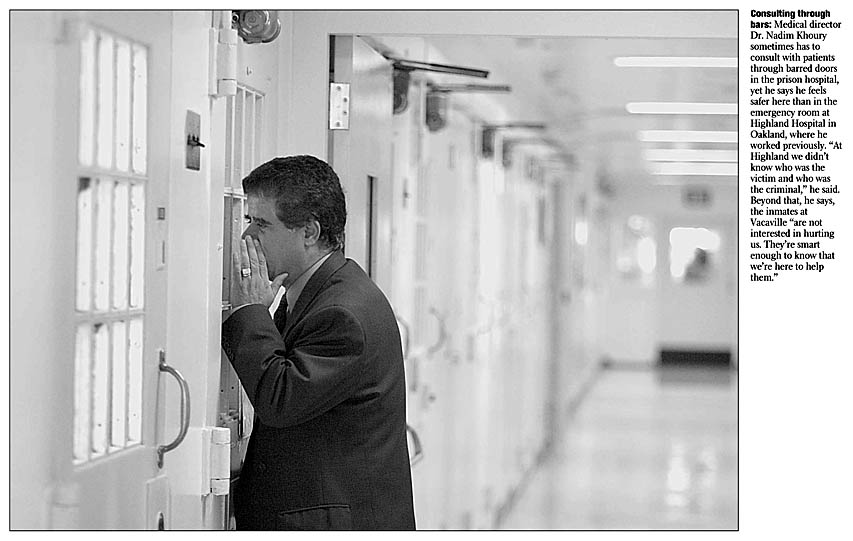
Photo credit sfgate.com. A physician "sees" inmates during a house call.
Scott McPherson
in Politics and government, influenza and infectious diseases
|
Post a Comment
 Helen Branswell is regarded as a kind of Edward R. Murrow of infectious disease. She is what I would call a Tier One infectious disease journalist, a person who gets a kind of reception at a bird flu summit normally reserved for celebrities and world-famous politicians, or other medical correspondents such as Laurie Garrett and Gina Kolata.
She also convinces her bosses at the Canadian Press to fly her all over the world covering H5N1, so we benefit from the relationships she has cultivated among the bird flu intelligentsia over the years. Truly, the world is her "beat."
Currently, she is in Singapore, covering a not-too-well-publicized gathering of scientists and public health policy leaders, sponsored by the World Health Organization. Dr. David Heymann, the leader of the WHO infectious disease effort, is chairing the meeting.
Ms. Branswell reports in her by-lined article that the WHO's meeting is attended by representatives of 24 nations, including the Big Four for H5N1 infections in humans: China, Egypt, Indonesia and Thailand.
 The issue is extremely dicey. This past January, as we all know, Indonesia's health minister (left) suddenly withheld vital H5N1 genetic samples, claiming intellectual property on the RNA. Since H5N1 was evolving/mutating in Indonesia, she claimed, the rights to all research should flow back to her nation. In fairness, it should be noted that this came - bada-BING! - immediately after an Australian vaccine maker produced a prepandemic vaccine made with WHO-certified Indonesian H5N1 antibodies, apparently without the host government's permission or consent.
We should also know that the nations whispering into Indonesia's ear with counsel to upset the apple cart of H5N1 sample distribution are none other than -- drumroll and sabre-rattling, please -- Venezuela, Cuba, North Korea and Iran. So geopolitics and "nonaligned" (my foot) nations are being H5N1 provocateurs against what they see as the unwillingness of the West to share vaccine. Give us vaccine, Indonesia says, and we will give you samples. Of course, this is inside-out logic. You can't make a vaccine without the samples. So Indonesia also took the step of signing a contract with Baxter Pharmaceuticals of the USA. Baxter gets the samples; they get to produce the vaccine; and the Indonesian government gets its way and gets its vaccine.
But while we castigate the Indonesian government for its shortsighted decision, we should also recognize its concerns. The poor of the world don't get vaccine on a good day, for all the usual and apparent reasons. That is one reason why the Bill and Melinda Gates Foundation has suddenly and very publicly entered the H5N1 prepandemic vaccine fray, to its enduring credit.
But read Ms. Branswell's article closely. There is another, perhaps more insidious force at work here. Quoting from her story:
"That the ensuing vaccine would be beyond the reach of developing countries in a pandemic is the main source of the conflict, though complaints about the sharing of credit on scientific publications have also fuelled the fire."
Excuse me, but I thought we were all working on the same team here. It is one thing to have (varying degrees of) legitimate national concern about protecting its citizens. It is another to squabble about credit. We all know the axiom, "Publish or perish," meaning if you don't publish, you won't get coveted government and endowment/foundation grants. But considering the magnitude of the potential pandemic -- and the fact that governments are throwing research grant dollars around like beads at a Mardi Gras parade -- I think everyone can get a slice of the pie, right?
 One of the best books I have read about infectious disease was Karl Greenfield's seminal work on SARS, China Syndrome. If you have not read that book yet, pick up a copy and read how back-door politics denied one researcher the chance to get his name in lights as the co-discoverer of the unique coronavirus that causes SARS. Apply the lessons learned to this situation. "Fight over academic credit stalls H5N1 breakthroughs", Branswell's headline might read, were it not for the fact she needs those sources to keep her abreast of what is actually going on "out there."
 If the Singapore meeting falls apart without reaching consensus on how samples are to be distributed and analyzed, we could be thrown back to the world of the 1950s, when the Lone Ranger was on radio and that newfangled idiot box known as television was just coming out and the rich neighbors down the street were the only ones who could afford it. How so? We will revert back to Cold War-era sample sharing. Nations that choose not to share samples will hamper much-needed research on the virus. The world's researchers will be unable to collaborate, credit or none, on much-needed breakthroughs in the understanding of influenza itself (let alone The Next SARS, etc.).
Let me remind the reader that the 1977 Russian Flu H1N1 rebirth was rumoured to have occurred because a Soviet flu lab experiment went awry. We would not have H1N1 around today, had it not been for that sudden re-emergence thirty years ago this month. Not too long ago, in a widely publicized "Doh!", a US flu lab mailed H2N2 (1957 pandemic) virus particles as part of its seasonal flu typing test kit. How will a lack of sharing impact the ability of the world to recognize a potential pandemic subtype, let alone prepare for it?
So prepare to return with us to those thrilling days of yesteryear, as we implore the Lone Ranger not to send Tonto to town! He might come back with more than a concussion and a sore jaw.
| (World News) Tuesday, 31 July 2007, 08:43 PST | |
| by Helen Branswell |
“We're very conscious that this is a precedent-setting meeting, as are most of the delegations,” said Dr. David Heymann, head of communicable diseases for the World Health Organization, under whose auspices the five-day meeting is taking place.
That's because the talks could change the conditions under which biological materials are provided to the WHO for global surveillance of and research on influenza viruses.
Depending on what is decided, the consequences could ripple far beyond the science of flu, experts say, conceivably affecting, for example, the pharmaceutical industry's ability to make and update an eventual HIV vaccine or limiting how quickly the world could respond to the next SARS-like disease outbreak.
“I think there's a heavy responsibility on the meeting, and then on the intergovernmental meeting which will follow (in November), to make sure that above all, considerations are made for public health security,” Heymann admitted.
Four countries from each of the WHO's six regions are at the table, including Britain, Canada, the United States, Indonesia, Vietnam, Thailand and Egypt.
The need to update the rules for sharing flu viruses stems from the demand of several developing countries, led by Indonesia, for affordable access to pandemic vaccine when the next global flu outbreak occurs.
Indonesia, the country which has lost the most lives to the H5N1 virus, has for much of this year refused to provide patient samples (from which viruses can be retrieved) to the WHO laboratory network, using the viruses as leverage in this debate.
Labs at institutes such as the U.S. Centers for Disease Control or Britain's Health Protection Agency isolate and study these viruses at the behest of the WHO, looking for changes that might allow H5N1 to more easily infect people or to evade the drugs used to treat flu.
When asked to do so by the WHO, they also make seed strains from important new virus variants, providing them free of charge to pharmaceutical companies for use in the manufacture of vaccine.
That the ensuing vaccine would be beyond the reach of developing countries in a pandemic is the main source of the conflict, though complaints about the sharing of credit on scientific publications have also fuelled the fire.
Many observers fear measures devised to address these concerns could lead to restrictions on how viruses that flow into the WHO system can be used, even by scientists.
Most are not willing to speak on the record about what is at stake in these highly sensitive talks.
“People are concerned,” admitted Dr. Adolfo Garcia-Sastre, an influenza researcher at New York's Mount Sinai School of Medicine.
Some fear a system could evolve where WHO labs could only look for limited information from viruses fed into the network.
Some envisage a scenario where this information could only be fed back to the contributing country, which could choose whether or not it should be shared with the broader scientific community. If some countries agreed to amalgamate findings and others did not, that could lead to huge gaps in understanding about how a virus is evolving.
Scott McPherson
in Politics and government, influenza and infectious diseases
|
Post a Comment
First, a big tip o' the cap to my buddy Mike Coston of Avian Flu Diary (http://afludiary.blogspot.com/). His Saturday blog about the Alabama Public Health pandemic simulation planned for tomorrow is excellent, and needs no interpreting from me. It makes me want to drive to Montgomery to watch things unfold.
Mike is absolutely right about the apparent turn toward a more realistic (fatalistic?) view of a pandemic. As tabletop after tabletop unfolds, and the sheer magnitude of even a moderate pandemic becomes apparent, planners take a more (and necessary) pragmatic view of the management of same. Mike mentions this at the end of his blog, and I absolutely agree. Those rosy assertions that "So-and-so county is ready for bird flu" are being replaced with a much more sober assessment of what has to be done.
Whether or not anyone in authority is listening is another question. Here is Mike's blog, reprinted in its entirety.
# 998
Pandemic drills are fairly common, and not terribly newsworthy. This small notice in the The Birmingham News today caught my eye for a couple of reasons.
http://www.al.com/news/birminghamnews/index.ssf?/base/news/1185007621186400.xml&coll=2
Saturday, July 21, 2007
 The Alabama Department of Public Health has scheduled an exercise at Garrett Coliseum in Montgomery on Tuesday to simulate an outbreak of pandemic influenza. The one-day drill will simulate a situation in which large numbers of people become ill. Only the sickest patients will be sent to the hospital, and home care will be stressed. An alternative care site also will be set up to care for influenza patients who have no caregivers. Finally, the exercise will demonstrate the distribution of antiviral medications to priority groups.
The Montgomery City-County Emergency Management Agency, Alabama Hospital Association, Alabama Department of Public Safety, local hospitals, American Red Cross, volunteers and health department staff from the Anniston, Mobile, Montgomery and Selma regions are participating.
Readers of this blog are certainly acquainted with the idea that, during a pandemic, most people will never see the inside of a hospital. We have roughly 1 million hospital beds in the United States, 90% of which are occupied at any given time, and a pandemic could simultaneously sicken millions across the nation.
Even if hospitals could maintain their current staffing levels, something highly unlikely during a pandemic, the surge capacity simply isn't there to handle millions of flu cases. We haven't the beds, or the personnel.
At some point, even the sickest of the sick may be turned away from hospitals. Most people will have to ride out the flu at home, cared for by their loved ones or friends.
This hospital crisis will affect those without the flu as well. Anyone who needs hospital care, whether it be for a heart attack, stroke, cancer, or trauma will find that the level and availability of care will be less than during normal times. Elective procedures may be canceled, and lets face it, going to a hospital filled with sick and infectious people might not be the healthiest thing someone could do.
The second thing that caught my eye was the statement that antivirals would be handed out to `priority groups'.
Exactly what that means is unclear. But given the limited amount of antivirals we will have available, it isn't terribly surprising. Whether antivirals are dispensed based on severity of symptoms, or some other criteria, there won't be enough to hand out indiscriminately.
Some surprisingly blunt admissions are creeping into the reportage of late. The sort of things you'd only have read in a blog a year ago.
I wonder if anyone is paying attention?
Thanks, Mike. Excellent as always.