
Entries in Politics and government (199)
Still more on adenovirus
 Scott McPherson
in Politics and government, influenza and infectious diseases
|
Scott McPherson
in Politics and government, influenza and infectious diseases
|
 Post a Comment
|
Post a Comment
|
 1 Reference
An entire thread on the Website FluTrackers.com http://www.flutrackers.com/forum/showthread.php?t=41234 bears reading and absorbing. The data seem to be pouring in now on adenovirus, especially ad14, the most interesting subtype. Follow this thread and download and read the medical texts.
Apparently, as Dr. Henry Niman and others have observed, this adenovirus is a recombining fool of an organism. Co-infections with up to three different types of adenovirus are not uncommon. And the virus has a foothold in other nations as well, including Egypt.
This situation bears very close watching. In some cases, the Case Fatality Rate for Ad14 approaches 25%. And testing for Ad14 is hardly ever done.
When I was associated with an IBM reseller, we learned one item from their lexicon: You don't know what you don't know. Clearly, we don't know the footprint of this virus, or how many people it actually infects, or how many times adenovirus has been misdiagnosed, or how many people it has actually killed and how many lives it has changed.
It is time to start finding out.
A most unwelcome visitor returns to Britain
Scott McPherson
in Politics and government, influenza and infectious diseases
|
Post a Comment
H5N1 has officially returned to Great Britain.
 This past Sunday, workers at the Redgrave Park Farm in Suffolk, near the border with Norfolk, made an unsettling discovery. In one of five poultry sheds on the property, the workers found sixty dead birds, DEFRA was quickly called and tests clearly showed the presence of high-path H5N1.
What is interesting is the proximity of the poultry operation to a lake teeming with wild migratory birds. About two football fields away, these wild birds -- including wild swans and Canadian geese - frolick.
Wild swans have also been the focus of H5N1 scrutiny in Germany and France. So the appearance of wild swans in an area also suffering an H5N1 infestation is certainly not, at first glance, coincidental.
Of course, the retail companies who would have ordinarily bought these turkeys, ducks and geese would now have you believe they had no plan to buy these fine, plump birds just before the holiday season started! One spokesperson said:
"The farm was due to supply us with a small percentage of our Christmas turkeys, ducks and geese. It is a relatively small farm and it would have accounted for less than 2.5 per cent of all our Christmas turkeys. We will be working closely with other farms that supply us and we are confident we will meet public demand."
Here is the article link, from the London Daily Telegraph:
http://www.telegraph.co.uk/news/main.jhtml?xml=/news/2007/11/13/nbird313.xml
The following snippet clearly shows that the British authorities are all too quick to throw those frolicking wild birds under the proverbial bus:
|
Migrating birds from eastern Europe have been blamed for bringing the deadly H5N1 strain of avian flu to Britain after it was discovered at a farm preparing to supply Christmas turkeys to Waitrose. Some 5,000 turkeys, 1,000 ducks and 500 geese are being slaughtered at the free range Redgrave Park Farm in Suffolk after H5N1, which has killed more than 200 people around the world since 2003, was identified. Acting chief veterinary officer Fred Landeg said the outbreak appeared to be "closely related" to ones this summer in the Czech Republic and Germany. "There is a lake nearby and there are a number of wildfowl of different species on the lake. As the turkeys, ducks and geese were free range we cannot exclude the possibility of mingling." |
I think these wild birds need legal representation. Recall that at first, the Bernard Matthews H5N1 fiasco was laid at the webbed feet of migratory wildfowl. But, as we learned later, it might only have been partially true. Matthews' poultry may indeed have been contaminated -- in Hungary. But then, the Hungarian turkeys were shipped to Matthews' processing plant in Britain, and all Hell broke loose last February. While the virus may be antigenically similar to Czech and German strains, the lineage is most certainly Qinghai -- and migrating wild birds and deficient industrial farming techniques may both be at fault here.
But news reports say these turkeys are free-range fowl, which conjures up images of fun-loving, blissfully ignorant turkeys running in slow motion toward other turkeys of the opposite sex, or else running toward the feeding troughs. But hold on there, Baba-looie! Maybe free-range is a nice feel-good word that simply means "gotcha."
From the Website http://www.eastbayanimaladvocates.org/, and its subsidiary Web page http://www.free-range-turkey.com/wst_page3.html :
According to the United States Department of Agriculture, the single condition for the term 'free-range' is that birds have access to the outdoors. All other facets of a free-range turkey's life can be indistinguishable from the living conditions of a conventional-raised bird.
University of California-Davis poultry specialist, Ralph Ernst reports: "Most free-range birds are still fenced in corrals, though people like to imagine the birds are out roaming the range. They're not out exercising. These birds are raised much like the regular turkeys." (3)
Thousands of free-range turkeys are raised in a single warehouse-like structure (known as a grow-out shed), forced to stand on accumulated fecal waste and breathe in ammonia fumes.
Recall the beginning of this story. Five sheds and 60 dead birds. So until we know exactly how free-range these free-range turkeys were, the jury is out on the immediate cause of the outbreak. And if the local wildfowl tests negative for H5N1, then we have a real conundrum on our hands.
The MRSA march continues -- on keyboards and in class
Scott McPherson
in Politics and government, Popular Culture, influenza and infectious diseases
|
1 Comment
 The stream of MRSA-related newspaper articles has now developed into a flood of print and online activity. here is a digest of a few of today's stories:
Palmetto High School in a very affluent suburb of Miami, Florida, has been hit with a MRSA infection. Specifically, five members of the football team have been diagnosed as MRSA-positive. In adjacent Broward County, the district is awash in MRSA-suspected cases -- and also awash in parent complaints about the safety of several local schools. The story is at the Miami Herald Website: http://www.miamiherald.com/tropical_life/story/288484.html .
The New York Times reports on the death of Brooklyn seventh-grader Omar Rivera (photo), who died of MRSA this week. The Times article also mentions that in neighboring New Jersey, state officials sent a memo to the superintendents of the state’s 615 school districts asking them to report any individual MRSA cases to the Education Department. Since then, districts have reported about two dozen cases among students and staff in recent weeks, officials said. Quoting from the Times story:
In recent weeks, reported MRSA cases have cropped up in schools around the New York metropolitan region. Students at two separate schools in Longwood, in Suffolk County, were discovered to have the infection by members of the nursing staff, who were told a month ago to watch out for the symptoms, said Michael R. Lonergan, the deputy superintendent.
In Southampton, school officials sent out general information about MRSA to parents last week and disinfected locker rooms and wrestling mats as a precaution before learning that three high-school students, all athletes, had become infected, according to the schools superintendent, J. Richard Boyes.
The story is at http://www.nytimes.com/2007/10/26/nyregion/26infect.html?pagewanted=2&_r=1&ref=todayspaper
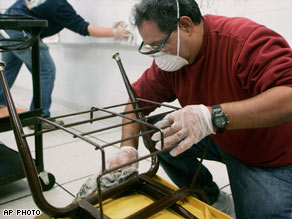 The photo at left is of a MRSA cleanup in a Chicago school. The task is being repeated in classrooms, gyms and cafeterias across the nation.
Alert blog reader Richard Schmitt of the Florida Department of Education sent me this AP/CNN story, regarding a MRSA scrubdown of an entire school district in Kentucky.
PIKEVILLE, Kentucky (AP) -- An eastern Kentucky school district with one confirmed case of antibiotic-resistant staph infection plans to shut down all 23 of its schools Monday, affecting about 10,300 students, to disinfect the facilities.The project will involve disinfecting classrooms, restrooms, cafeterias, hallways, locker rooms, buses and even external areas such as playgrounds and sports fields, said Roger Wagner, superintendent of Pike County schools.
"We're not closing schools because there's been a large number of breakouts, but as a preventive measure," Wagner said.
Two weeks ago, students staged a sit-in at the lunch room of Pike Central High School in effort to get school officials to clean the school as protection against the bacteria.
Most abandoned the sit-in after Principal David Rowe threatened them with a three-day suspension, but 33 stayed and were given the choice of one day of in-school suspension or two days out-of-school suspension.
Three chose out-of-school suspension.
A wise choice for the students. The story is at http://www.cnn.com/2007/US/10/27/mrsa.school.cleaning.ap/index.html .
So the truth is out there, Mulder, and the truth is we have a massive, underground, unreported epidemic of MRSA rolling across the nation. Everything from wicked-looking scrapes to misdiagnosed brown recluse spider bites are probably, in fact, MRSA infections (see my earlier blog, http://www.scottmcpherson.net/journal/2007/10/24/excellent-apmsnbc-story-on-lax-hospital-protocols.html, for details).
Some think the story is overblown, and many in the media and the Blogosphere equivalent of the Flat Earth Society are dismissing the MRSA flood of stories as the New Bird Flu. Of course, if you are reading this, then you know what side of THAT debate you sit on. But it is preposterous to poo-poo MRSA as much ado about nothing when we do not even know the tip of the iceberg regarding potential vectors of infection.
Speaking of vectors of MRSA infection, how about this one? A link to a research paper was sent to me by alert blogger Robyn Klein, AHG herbalist, MSc. Medical Botany, and an adjunct instructor with the Department of Plant Sciences and Plant Pathology at Montana State University. Her blogsite is http://www.rrreading.com/index.html.
The paper is titled "Public computer surfaces are reservoirs for methicillin-resistant staphylococci", and the authors are Issmat I Kassem, Von Sigler and Malak A Esseili of the Laboratory for Microbial Ecology, Department of Environmental Sciences, University of Toledo, Toledo, Ohio. I was able to procure the paper privately.
The following is just from the foreword!
The role of computer keyboards used by students of a metropolitan university as reservoirs of antibiotic-resistant staphylococci was determined. Putative methicillin (oxacillin)-resistant staphylococci isolates were identified from keyboard swabs following a combination of biochemical and genetic analyses. Of 24 keyboards surveyed, 17 were contaminated with staphylococci that grew in the presence of oxacillin (2mgl1). Methicillin (oxacillin)-resistant Staphylococcus aureus (MRSA), -S. epidermidis (MRSE) and -S. hominis (MRSH) were present on two, five and two keyboards, respectively, while all three staphylococci co-contaminated one keyboard. Furthermore, these were found to be part of a greater community of oxacillin-resistant bacteria. Combined with the broad user base common to public computers, the presence of antibiotic-resistant staphylococci on keyboard surfaces might impact the transmission and prevalence of pathogens throughout the community.
The article is available for purchase at: http://www.nature.com/ismej/journal/v1/n3/abs/ismej200736a.html.
All-righty then! Public keyboards -- in universities, in libraries, in classrooms, at kiosks, at ATM machines, I'll let you fill in your imagination here -- are now proven vectors of MRSA. This means that the equipment kids use in school has to be decontaminated frequently, and probably daily.
I will say what everyone is, or should be, thinking. We are ushering in the Golden Age of Disease. Killer bugs, resistant to the best antibiotics, are growing in our schools, prisons, jails, colleges, hospitals, and probably churches too if we bothered to check. Influenzas with the capacity to kill hundreds of millions are brewing in the bellies of wild birds, in the throats of unknowing chickens and ducks, and in God knows how many pigs, cats and dogs across Asia. Mosquitoes are spreading across the developing world with almost unthinkable misery-causing and deadly pathogens.
And it is all heading our way. MRSA just beat the rest to Home Base. Home base is every playground, school, gymnasium, hospital and public meeting place in America.
Makes you want to start using your gloves now, doesn't it? How we manage such issues as seasonal flu, MRSA, and other diseases gives us clues as to how we will manage the Next Pandemic.
Early returns show we won't fare well at all.
When Labs Attack, Part II
Scott McPherson
in Politics and government, influenza and infectious diseases
|
Post a Comment
 Earlier this month, I wrote a blog about the potential for a lab accident spawning the Next Plague. Titled "When Labs Attack," it can be found at: http://www.scottmcpherson.net/journal/2007/10/2/when-labs-attack.html .
Now, an article in the Dallas Morning News rekindles the debate, with an even more impressive (read:scarier) set of statistics, plus a revelation regarding Texas A&M University's lab accident history. None of this would be common knowledge without the efforts of watchdog group The Sunshine Project (http://www.sunshine-project.org/). The Sunshine Project was told of several problems at the university's brand-new facility, including the infection of a researcher with bruscella, a potential biological agent. The researcher was improperly cleaning a container called a Madison Aerosol Chamber (A-ha! Madison, now where have I heard "Madison" and "lab accident" recently! Oh yes! More on that later). By the way, this happened almost two years ago, and just started coming to light this past Spring.
Anyway, read this nightmare narrative from the Sunshine Project's report:
By April 2006, the researcher had "been home sick for several weeks." Nobody apparently suspected brucellosis, despite the occupational exposure and, presumably, familiarity with its symptoms. Eventually, the researcher's personal physician ordered blood tests and made the diagnosis on about April 10. On 15 April, the infected researcher began a heavy treatment course reflecting the severity of the situation. She received a week of intravenous antibiotics followed by a 45-day course of two additional antibiotic drugs. Just over a month later, new blood tests indicated that the infection had passed. (bold mine)
The full report is available at: http://www.sunshine-project.org/publications/pr/pr120407.html . So a bunch of scientist dunderheads failed to match the symptoms of bruscella infection with the condition of the researcher, who had climbed into the chamber and had been absent for several weeks? Where did they think she went, Lollapalooza? And we are funding these brainiacs?
Now, where did I recently hear of Madison? Oh yes, the University of Wisconsin-Madison's attempt to work with what I call a "fax" of Ebola in a biocontainment facility not rated for such experiments. I covered that little faux pas in When Labs Attack. Anyway, the Madison Aerosol Chamber is a joint development of the Baker Company and the University of Wisconsin-Madison's mechanical engineering department, presumably also with the assistance of the infectious disease department. The PDF file of the Madison Aerosol Exposure Chamber, can be found at: http://www.bakerco.com/lib/pdf/benchmarks/Summer2006.pdf
Anyway, the document details very clearly the risks associated with the use of this device. Apparently, the Aggies did not read the manual. Figures, they didn't put 2 and 2 together and almost killed one of their own, so why should we think they would bother to RTFM (a nice acronym frequently used by frustrated computer support people)?
The Houston Chronicle also reported on the matter, albeit in September. Apparently, the problems did not become public knowledge until the CDC sent a letter to the administration at Texas A&M regarding the multiple hazards. Here is a digest of the story:
Texas A&M Says It Will Deal With Safety Issues Regarding Research on Pathogens
Texas A&M University at College Station is working with federal officials to allay their concerns about safety and security violations in laboratories at the institution that study dangerous microbes, the university's interim president, Eddie J. Davis, said on Thursday.
A dozen such violations were outlined in a critical letter from the federal Centers for Disease Control and Prevention that was made public on Tuesday (The Chronicle, September 5). Those violations included the university's inability to account for at least three vials of microbes, which the CDC described as "missing," and instances in which researchers worked with regulated bacteria without having received permission, or entered labs that they did not have permission to enter.
OK, let's cease the attacks on the Aggies and focus on the larger issue. They have a mediocre football team and probably won't finish bowl-eligible anyway,
Ever since 9/11, with the Japanese Sarin gas attacks and Saddam Hussein's chemical weapons attacks upon his own people both squarely in the rear view mirror of our consciousness -- along with the knowledge that Soviet scientists were up to some diabolical things that could now be sold to the Highest Terrorist Bidders -- the US government set about to do as much research on defeating biological and chemical Weapons of Mass Destruction as possible. The Peace Dividend would be the ability to protect Americans and our allies from the scourge of such attacks if they came naturally, as well as being cooked up in some Iranian, Hezbollah, Al Qaeda or North Korean lab.
The Dallas Morning News is reporting that some 15,000 Americans are now licensed to work on these dangerous pathogens. And like all humans, they are prone to making mistakes. Except this time, the mistakes can be fatal. Read this list of boo-boos from the article:
•In August in Great Britain, contamination of foot-and-mouth disease was discovered at several farms near top-security labs working with the live virus. Investigators found leaking pipes and poor drainage at the labs and they believe contaminants got into farm soil.
•In August, a lab worker at St. Louis University was stuck with a needle contaminated with monkeypox, a disease similar to smallpox.
•In June, an hourlong power outage at the CDC's newest top-security lab outside of Atlanta raised serious questions about the safety of the agents inside the facility, after the backup generator failed to deploy.
•In May, a lab employee at the University of Kentucky was exposed to plague bacteria after a protective bag leaked.
•At the University of Texas at Austin in April, a researcher mistakenly came into contact with a cross between the bird flu and human flu. The researcher was put on drugs and the lab was shut down for decontamination. (bold mine)
•In 2006, a lab worker at Texas A&M University was infected with Brucella and later that year, several researchers were exposed to Q fever. A&M failed to report the incidents at the time. Since the news broke this summer, at least a dozen other violations have surfaced. A&M has had its biodefense research suspended while the university tries to clean up the program.
•At the University of Wisconsin in 2005 and 2006, researchers handled the Ebola virus in labs not approved for it.
•At the University of Chicago in 2005, a lab worker punctured his or her skin with a needle contaminated with anthrax.
•A Russian researcher died in 2004 after being exposed to Ebola in a lab. (bold mine)
•In 2004, a researcher at the Medical University of Ohio was infected with Valley Fever. The following summer other workers were exposed to the same agent.
•Three lab workers were infected with tularemia at Boston University in 2004, but the infections weren't immediately reported to authorities.
•Several Chinese researchers working with SARS in Asia in 2003 and 2004 were infected with the disease. One individual died. (bold mine)
Continuing with the story:
The CDC has conducted more than 600 lab inspections since 2003 and referred nearly 40 lab operators to federal investigators for violating "select agent" regulations, said Dr. Richard Besser, the agency's director of terrorism preparedness.
And despite the fears surrounding biodefense research, U.S. biosafety experts say, public health risks are remarkably low. Of the 105 biosecurity breaches involving select agents reported to the CDC since 2003, only three involved lab worker illnesses.
Those comments are designed to make you feel better. Let me also throw out these stats, also from the same story. I intersperse commentary:
Though no official count exists, federal investigators estimate there are between 400 and 1,200 high-security labs operating in private and academic settings, many of them in or around major urban centers.
No official count? NO ONE in the Federal Government has a handle on how many of these potential incubators of virus are operating?
Fifteen of those labs are Bio-Safety Level 4, or "BSL-4" – the facilities equipped to handle the world's most dangerous pathogens. That's up from just five BSL-4 labs operating in 2001.
So we have increased the number of Ebola-ready biohazard labs by a factor of three.
In a report prepared for lawmakers this month by the GAO, Congress' investigative arm, officials questioned 12 federal agencies involved with biodefense research – from the Environmental Protection Agency to the Department of Defense – to find out whether they tracked the growing number of infectious disease labs in the U.S.
None did, the report said. (bold mine)
Nor were any of the agencies solely responsible for determining how many more labs were necessary, monitoring the research performed there, or analyzing the risks associated with the burgeoning biodefense program. The findings have been confirmed by independent researchers.
Federal officials say while there may not be a single government body that oversees the country's biodefense research, each of the 12 agencies plays a specific, designated role – whether it's reviewing grant proposals, overseeing experiments and results or reporting lab accidents.
I remind you that according to the Pope of Influenza himself, Dr. Robert Webster, the reason why we have H1N1 today is the result of a Soviet lab accident in 1977 that released a derivative of the 1918 Spanish Flu virus upon humanity. The strain received the nickname "Russian Flu" because it was typed in Russia. Recall that influenza plays "King of the Mountain" and it is exceedingly rare that two strains of Influenza A exist at the same time en masse among humans. At least not until 1977, anyway. That accidental release sparked the "age-specific pandemic" among people who were born after 1956. Prior to 1956, H1N1 was still the dominant strain of Influenza A. People born after 1956 had no immunity to H1N1. So the artificial emergence of H1N1 created pandemic conditions for anyone born in 1957 or later.
The Sunshine Project's Edward Hammond puts it best: "But we have gone way too far, to the point that I believe that the most likely source of a bioterrorist event in the U.S. is a U.S. biodefense lab."
Hat-tip to www.birdflubreakingnews.com and FluTrackers poster Tropical for pointing out the Dallas Morning News story.
Perspective needed on HHS Flu Vaccine Allocation Plan
Scott McPherson
in Politics and government, influenza and infectious diseases
|
3 Comments

The news media (to the extent they are not covering Britney Spears' underwear, marital problems or inbibing habits) have generated many stories regarding the recent release of the draft HHS vaccine distribution guidelines.
It is my pleasure to now talk about The Elephant In The Room that everyone has so convenienty neglected.
This follows a telephone interview with Computerworld's Patrick Thibodeau. Pat is one of the few reporters who habitually reports on avian influenza and its potential pandemic effect on the information technology sector. Pat rang me up to get my opinion of the draft HHS vaccine guidelines. Where does IT fit on the tiered ladder? How would an organization determine where it is in the pecking order (sorry) for vaccine?
After breaking down the draft guidelines, I then spoke of that danged elephant. It is a message that bears repeating over, and over, and over again.
A vaccine -- ANY vaccine, save possibly the prepandemic goulash that is cooking in (far too many) labs across the world -- will not be in your arm for at least six to eight months following the start of an influenza pandemic. That is Wave Two, maybe even Wave Three of the pandemic, since we have no idea whatsoever how many waves the Next Pandemic will be, or how long it will take each wave to travel. Even that six to eight month vaccine timeframe is for Tier A and B receipents. Forget about the general public. Vaccine will be trickling out with agonizing slowness.
We also do not know if the virus will be moderate or severe (the report says in a light to moderate pandemic, don't even sweat the vaccine). And we don't know if, like 1918, the second wave will be the killer. Recall it was the third wave in 1919 that felled President Woodrow Wilson at the most sensitive stage of the armistice talks and, ultimately, set the stage for the Third Reich. And remember that in 1976, with far more manufacturers and a Get Out of Court Free vaccine boo-boo cards courtesy of the Congress, they still had to throw out millions of doses of vaccine because the virus drifted during the manufacturing process. There is no guarantee the same thing won't happen again. Heck, it happens routinely today.
So any organization that is seriously concerned about its place in the pecking order for vaccine is decidedly missing the point. That point is that there will be a six to eight month window of incredible suffering, lost wages, declining economic news, hunger -- and death -- for many months prior to the availibility of vaccine. That means organizations need to focus NOW on such basic things as hand sanitizer, gloves and masks. They need to focus on Tamiflu if they can get it, but if they can't, then they need to focus elsewhere. All need to focus on the things that Momma taught us -- hand washing, personal hygiene, and keeping a respectable distance from strangers.
 The report is available as a PDF file from www.pandemicflu,gov, specifically at the following location: http://pandemicflu.gov/vaccine/prioritization.pdf .
I close with the recent words of former Surgeon General C. Everett Koop, who said: "We're fighting today's pandemic with the same tools we had one hundred years ago."
Take those words to heart and prepare for what you can do today.