
Entries in Politics and government (199)
WHO, US Navy send teams to probe human bird flu clusters in Pakistan
 Scott McPherson
in Politics and government, influenza and infectious diseases
|
Scott McPherson
in Politics and government, influenza and infectious diseases
|
 1 Comment
|
1 Comment
|
 1 Reference

The two most famous survivors of H5N1 since Jones Ginting are pictured at left.
Pakistani brothers Mohammed Ishtiaq, right, and Mohammed Tariq, left, who were treated for suspected H5N1 bird flu, come out from their house in Sukur village near Peshawar, Pakistan on Saturday, Dec. 15, 2007. Six people caught H5N1 bird flu in northern Pakistan last month and at least one person with the disease has died, the government said Saturday. The U.N. World Health Organization confirmed the deadly H5N1 strain was found in the six cases, but said a second round of tests were being carried out to make sure. (AP Photo/Mohammad Zubair)
The WHO has gotten their Boots on the Ground in Pakistan. They are accompanied by top-flight staff from the world-famous US Navy research lab, headquartered in Cairo (NAMRU-3). They are all charged with finding answers that may or may not ultimately invoke Phase Four on the Big Board. Specifically, the situation in Mansera and Peshawar, Pakistan, is growing more disconcerting, as some media reports are reporting that a third family cluster has arisen. That third cluster of human cases would be the cousins of the many brothers infected (or suspected to have been infected) by H5N1.
To recap: Pakistan has had anywhere from six to nine confirmed cases of human H5N1. All indications -- from the onset of symptoms to the dates of death for the dead brothers -- point to classic human-to-human infection of Influenza A. Two separate families are confirmed to be involved, and the third is awaiting confirmation. Check my blog http://www.scottmcpherson.net/journal/2007/12/14/all-eyes-on-pakistan-as-h5n1-h2h-transmission-grows-more-pro.html
The two towns in question are very close together. Flusite poster Hawkye has started a map pinpointing the locations of the clusters. The site can be reached at: http://hawkeye00x00.awardspace.com/map/mapit.php?mapid=pakistan.xml . By the way, note the proximity of the two towns to the Tarbela Reservoir, a large body of water in the area.
The topic now turns to determining just how many brothers are in this index family! From what I can figure out, the brother at right in the photo above is the index case, Patient Zero if you will. He is the veterinarian and helped in the culling of poultry in late October. The brother (Jean Reno look-alike) at left also tested positive for H5N1. Counting their two dead brothers, that would be four suspected cases and three confirmed cases in one single family. No samples were taken of one of the two dead brothers, inexplicably.
Now to the day laborer/culler: According to the Frontier Post (a Peshawar, Pakistan Newssite), the infected culler, his niece and another person are positive for H5N1, albeit less severe. That makes three more, which brings us to six comfirmed human cases of H5N1.
The site also attempts to clear up the confusion surrounding patient Zero's US-resident brother, but adds some even more troubling news:
New York State health officials were informed Dec. 7 that a man from Nassau County who had returned from Pakistan told his doctor he might have been exposed to avian flu, said Claudia Hutton, director of public affairs for state department of health. The man went into voluntary quarantine at home, Hutton said. Then his son began developing flu-like symptoms. Samples from both man and his son were tested at state laboratories and at U.S. Centers for Disease Control and Prevention in Atlanta. CDC sent an airplane to Albany to pick up samples. The samples came back negative for H5N1 avian flu this week, and man and his son are no longer in quarantine, he said. He said there were erroneous reports on Internet that another brother of H5N1-infected family members in Pakistan returned to the U.S. and tested positive. The remaining suspected cases in Pakistan include a man and his niece, and a male who worked on a nearby farm. (bold mine)
Apparently, the reports of the CDC being Johnny-on-the-spot were wrong. They were notified by the brother that he had traveled to Pakistan. The CDC were not waiting for him on the tarmac, bunny suits at the ready. The family doctor called the health department. Imagine for a moment if the two were asymptomatic carriers of H5N1. Yeah, it scares the beejeesus outta me, too. The newssite is at: http://www.thefrontierpost.com/News.aspx?ncat=hn&nid=640 with a big hat-tip to flusite poster Commonground. The official New York State Department of Health press release regarding the sequence of events is available at: http://www.health.state.ny.us/press/releases/2007/2007-12-16_nassau_county_resident_tests_negative_for_bird_flu.htm with a hat-tip to flusite poster Dark Horse.
 Anyway, the Canadian Press' Helen Branswell (photo) is also covering the situation, and one hopes the Canadians can cough up (no pun intended) the airfare to get her over there with an interpreter! Ms. Branswell reports:
There was some confusion Saturday about how many people had tested positive for the virus, with Pakistan announcing six cases but an official of the World Health Organization suggesting as many as nine people may have tested positive for the virus in that country.
The WHO spokesperson said investigations are still under way to try to determine how the various people became infected, but some human-to-human spread is possible.
“We can't rule it out,” WHO spokesperson Gregory Hartl said from Geneva.
“There are other plausible explanations.... We don't know enough at this point. And in some of these cases, one never will know enough.” (bold mine)
http://www.theglobeandmail.com/servlet/story/RTGAM.20071215.wpakbirdflu1215/BNStory/International/home
My point exactly. We may never know conclusively if this virus attained efficient H2H transmissibility in Pakistan. But if medical authorities suspect it strongly, is that not evidence enough to press the button and move to Phase Four? That is where the US Navy's NAMRU-3 unit comes in. If anyone can find the answer quickly, they can. They are remarkable. To learn a quick tidbit about NAMRU-3, read my blog http://www.scottmcpherson.net/journal/2007/7/22/new-bird-flu-case-in-egypt.html .
Almost on que with my earlier post on the simultaneous threat of H2H H5N1, the WHO issued this statement:
WHO warns countries to be vigilant as bird flu flares in Asia
HANOI, Vietnam: The World Health Organization warned Monday that countries should be on alert for bird flu because it is again on the move, with Pakistan reporting new infections and Myanmar logging its first human case.
"The key to the public health response is surveillance," said Peter Cordingley, spokesman for the WHO Western Pacific region in Manila. "If we do actually get to the cases with antivirals early on, the health outcome is a lot better."
WHO experts arrived in Pakistan to try to sort out cases reported there, South Asia's first human infections. They were expected to visit a hospital and affected areas Tuesday, said WHO country representative Khalif Bile in Islamabad.
"They are here to get more information and to provide more support in the case of any potential risk," he said, adding that the Health Ministry, Agriculture Ministry and WHO are now working closely together following a "communication gap" when the government did not immediately report suspected cases to the WHO.
Four brothers and two cousins fell ill last month in Abbotabad, a small city north of Islamabad, while three others who slaughtered poultry in the same area and a nearby town tested positive for the H5N1 bird flu virus earlier this month.
Two of the brothers died, but specimens were collected from only one.
The cases were positive for H5N1 in initial government testing, but WHO will conduct further analysis to confirm the results.
WHO spokesman Gregory Hartl in Geneva said Sunday human-to-human transmission had not been ruled out, but added that poultry outbreaks had earlier been reported in the area and it was unclear if all patients had links to sick birds or infected surroundings.
A doctor who cared for the brothers also experienced mild flu-like symptoms, but more testing needs to be carried out to determine if she was infected, Hartl said.
Two poultry farms near Abbotabad have been closed and health workers are taking temperatures of those living in the affected area twice a day, but no new suspected cases have been reported, said Minhajul Haq, a district health officer.
"We are on high alert, though we still await any confirmation of human-to-human transmission," he said.
At least 208 people have died from the virus, which began plaguing Asian poultry stocks in late 2003. It remains hard for people to catch, but scientists worry it could mutate into a form that spreads easily among people, potentially sparking a pandemic.
With fresh poultry outbreaks reported in a number of countries, including Germany over the weekend, WHO urged nations to be vigilant in identifying and reporting cases in both birds and humans.
Myanmar's first human case was reported Friday in a 7-year-old girl who fell ill last month and survived, while Indonesia, the country hardest hit by the virus, has announced its 93rd death from the virus.
Two human cases were also recently confirmed in China, one of whom died.
The H5N1 virus often flares during the winter months. In some countries, like Indonesia, poultry outbreaks and human cases are reported year round, but many countries experience a flurry of activity when temperatures drop.
"It starts to pop at this time of the year, not just in this region where it's endemic, but it starts to appear in the West," Cordingley said. "Between now and April is a very dangerous time of the year."
Most human bird flu cases have been linked to sick birds, but experts suspect limited person-to-person transmission may have occurred in a few cases involving blood relatives. (bold mine)
Interesting that the WHO is now picking up the H2H mantra. When dealing with risk communications, it is critically important to stay "on message" and not give mixed signals. How many times have we watched with incredulity as a government, while trying to prepare its people for a flu pandemic, downplays the seriousness of a poultry outbreak of H5N1?
You cannot try to raise awareness and concern about an influenza pandemic, and then tell people a poultry outbreak is not a cause for alarm. My God, two weeks ago the Polish were selling H5N1-tainted raw chicken and EGGS in their supermarkets! Patting people on the back and reminding them that cooking poultry thoroughly will kill virus is of no consolation to some hapless sod who orders his eggs over easy and gets them runny in a Polish restaurant, or gets an accidentally undercooked chicken there.
Transparency in the most unlikely of places
Scott McPherson
in Politics and government, influenza and infectious diseases
|
Post a Comment
 Like most flu watchers, I was struck by the seemingly contradictory behavior of the government in Myanmar last week. Unless you live in your own universe where you are the deity, you are painfully aware of the situation regarding the military dictatorship's antipathy towards anything even remotely resembling freedom, democracy and transparency. There are even hushed rumors that in the last round of anti-government demonstrations in that country (previously known as Burma) this past September and October, hundreds -- if not thousands -- of Buddhist monks were killed and (even more horrifying), there are allegations that several injured monks were cremated alive. http://209.85.207.104/search?q=cache:YDx3ElhwIqsJ:www.globalvoicesonline.org/2007/10/02/myanmar-list-of-detainees-and-letter-from-a-88-generation-worker/+myanmar+government+priests+killed+2007&hl=en&ct=clnk&cd=3&gl=us
So what can scare one of the most repressive regimes in the world into calling the World Health Organization?
Bird flu.
One can only imagine the telephone call that took place. Only Bob Newhart could do that call justice.
"W.H.O. bird flu clearinghouse Geneva. You want to report a suspected case? Where are you calling from?
"You're kidding, right? This call is from Myanmar? C'mon, who is this really?"
Anyway, a young girl came down with H5N1 bird flu last week, and before you could say "Gesundheit!" (by dictatorship standards), the Myanmar authorities had the WHO on the line . From the Miami Herald, via AP:
Myanmar reports 1st human bird flu case
The U.N. body and the country's health ministry found that a 7-year-old girl from Keng Tung in northeastern Myanmar had been infected with the deadly H5N1 virus, WHO said on its Web site Friday. She has since recovered.
The WHO hailed Myanmar's transparency and swift action in alerting outside health officials about the case. Myanmar's ruling junta has been under international fire since September for killing and arresting pro-democracy protesters, with dissident groups putting the death toll at about 200.
"They handled it very, very well," said Shima Roy, spokeswoman for the organization's regional office in New Delhi. "They actually did house-to-house surveillance, especially in the area where there had been an outbreak of avian influenza in poultry."
State media reported the girl was hospitalized on Nov. 27 and released on Dec. 12 in good condition after being treated with the antiviral drug Tamiflu.
Bird flu has recently resurfaced in parts of Asia, with human deaths reported in Indonesia and China and fresh outbreaks in poultry plaguing other countries during the winter months when the virus typically flares.
According to the WHO, there have been 340 cases of bird flu in humans worldwide since 2003 - 208 of them fatal.
Experts believe most human victims of the virus were infected through direct contact with sick birds. Although bird flu is difficult for humans to catch, experts fear it could mutate into a form that spreads easily among people and spark a flu pandemic.
The young victim, Nan Kham Than, was among four people suspected of having the virus during an outbreak of the disease in poultry in mid-November, the state-controlled New Light of Myanmar newspaper said. Laboratory tests confirmed that only the girl was infected.
The Health Ministry for 10 days closely monitored 689 persons who were involved in culling chickens or lived near the affected farms, and found that no other people were infected, the newspaper said.
Myanmar reported its first bird flu outbreak in March 2006 in the central part of the country, but until now had reported no human infections.
H5N1 began ravaging Asian poultry stocks in late 2003, leading to the death or slaughter of millions of birds.
http://www.miamiherald.com/news/world/AP/story/345709.html
Kudos to Myanmar for their swift reporting of the case and the equally swift transport of virus samples for analysis. One step toward transparency, no matter how small, is cause for celebration.
It is sometimes worth remembering, however, that dictatorships have an easier time of controlling bird flu than democracies. House-to-house searches are nothing new to an enslaved people.
But it is worth noting that Myanmar did what Indonesia steadfastly refuses to do -- promptly notify the WHO and then equally promptly send virus samples to Geneva.
What a bitter irony it would be if the Indonesians continued their ridiculous withholding of virus samples until they had solid assurances that they would be first among equals for vaccine, and then the virus mutates in, say, Myanmar or Pakistan, and Indonesia has no leverage left because their samples were then worthless? They would have mortgaged their peoples' lives for nothing -- not to mention the rest of the worlds'. And they would be in the same spot they were in previously -- standing in line, waiting for whatever tablescraps were left.
No, I take that back. they would be in a decidedly worse spot, because of the ill will they have generated with the industrialized world.
All eyes on Pakistan as H5N1 H2H transmission grows more probable
Scott McPherson
in Politics and government, influenza and infectious diseases
|
3 Comments
|
1 Reference
 The confused jumble of media and medical reports coming out of Mansera, Pakistan is beginning to stabilize. With that stabilization, we are beginning to get a picture of activity that is much more serious than originally assumed.
First, massive tips of the cap: The Flusites are absolutely nuclear with activity on this topic right now, with Flu Wiki and Flutrackers leading the way (you can click a link to them via this Website). Dr. Henry Niman at recombinomics.com is doing his usual excellent job of sorting through the maze and reading between the lines. Plus, all the A-list flubloggers -- Mike Coston, Crawford Kilian, SophiaZoe and others (just a click away via this site) -- are maintaining excellent lines of communication.
Distilled from all these sites and opinions and translations, here is what apparently has happened:
In one of the numerous Pakistani H5N1-related bird culls of the past few months, a veterinarian appears to have been exposed to the H5N1 avian flu virus last October. Remember that date. He then, by all appearances, transmitted the virus to one or more of his brothers. They died ten days apart, strongly suggesting a chain human-to-human transmission, precisely because of the lag times. If the two sons were infected by, say, eating a diseased chicken at the same dinner table, or even as leftovers, the infection incubation period -- and therefore the deaths -- would have occurred much more closely together.
But they didn't, and the timetable gets really scary here. If the vet brother (A) gets infected in October during the cull, and one brother (B) dies on November 19 and the other brother (C) on November 29, there is reason to strongly suspect the infections were passed down like a daisy-chain. Human to human. Chain transmission.
The next wrinkle is really something. There was another brother (D) of the vet, and who is a resident of -- drum roll, please -- the United States! He gets the word that brother B died November 19th, and goes home to Mansera, Pakistan. He then manages to contract bird flu himself and tests positive for the disease. After hospitalization and confirmed recovery, he returns to the Long Island, New York area. Immediately upon his arrival at the airport in Nassau County, New York, local health authorities and the CDC immediately place him (D) in quarantine and test him thoroughly until it is determined he tests negative for H5N1 and is now safe to release. Kudos to the CDC and the authorities in Nassau County, New York. So the CDC can find people now! That is a comforting fact.
So to recap: Four brothers (ABCD) are in the first cluster family, one a vet. And that vet was, by newer media accounts, the sole person to expose himself to poultry during the cull. Two brothers are now dead, and the remaining two have tested positive for H5N1.
At the same mass bird cull that the veterinarian attended, a day laborer also contracted H5N1. He is in hospital. the culler's daughter is either in the hospital with bird flu-like symptoms or simply under observation, depending on the accounts. Family contacts of all infected are under observation and, one would hope, also under isolation. .So a second potential cluster develops from the same cull.
All this sounds eerily similar to the outbreak of highly pathogenic H7N7 in the Netherlands in 2003. As you recall, a veterinarian died in that outbreak, and human-to-human transmission was thoroughly documented by medical researchers (http://www.eurosurveillance.org/em/v10n12/1012-222.asp). That study's abstract concluded:
Further seroprevalence studies among contacts of asymptomatic H7 cases should be conducted.
So we have as close to a confirmed familial cluster of H5N1 that we have witnessed since May, 2006 in Indonesia. And we have another potential familial cluster with the culler/laborer. There may be a third cluster, but I believe we are seeing the "fog of war" syndrome as the Pakistani press tries to sort out some erroneous and conflicting dates and test results.
Anyway, if we have two clusters or three, that is two to three too many for the Pakistani government to tolerate. So today, the entire nation of Pakistan went on medical alert. In a scene that reminds me of the end of Howard Hawks' classic The Thing from Another World, when the call "Watch the skies! keep looking, keep watching the skies!" goes out via the wireless all over the world, local health departments in Pakistan are especially tasked with reporting ANY "untoward" situation. They are clearly worried that, on this farm in Pakistan last October, Qinghai H5N1 (Clade 2.2) may have developed the capacity for efficient human-to-human transmission.
This should not surprise anyone in the least. Who knows how many times since 2003, culling has prevented (or postponed) the Next Pandemic? Go back to December, 1997, when then-Hong Kong health officer Dr. Margaret Chan may have saved the planet from a pandemic when she ordered the death of every bird in the city? At the risk of a bullet in the back of the head from her brand-new Communist Chinese handlers (Hong Kong passed from British to Chinese control in June, 1997), she made the decision to defy the totalitarian leaders and tell the truth. As we know today, she runs the WHO.
I personally believe that the mutations necessary to change H5N1 to a lethal and efficient killer of humans can take place in multiple environments in multiple areas of the world at the same time. These simultaneous "tipping points" are why we need to look at the Big Picture, rather than become focused merely on one flashpoint. If chain H2H is happening in Pakistan, then right now, anywhere else on the planet H5N1 causes an outbreak in poultry, we now need to be extremely vigilant in our search for the presence of human clusters. Everywhere.
Pushing the Button
Scott McPherson
in Politics and government, influenza and infectious diseases
|
5 Comments
 The politics of going to Phase Four.
For the first time since H5N1 avian influenza has been tracked by the WHO, there is compelling evidence of simultaneous clusters of possible human-to-human transmission occurring in multiple nations with little physical proximity between them.
Specifically, the locations are China, Indonesia and Pakistan. In all three cases, people have died who were family members. And what is equally distressing is that the third location -- Pakistan -- has previously never reported a confirmed case of human H5N1 infection.
We also know that on at least two different occasions within Indonesia, in the past 13 months, the WHO had vast quantities of Tamiflu distributed to thousands of villagers. This was done in an attempt (so far successful) to prevent a cluster from growing into an outbreak. Those two times were August, 2006 and September, 2007. We all know of the August 2006 "blanket" of Tamiflu over four remote villages within a few clicks of each other; but we never heard about the results of the Palua Tabuan blanket. Palua Tabuan is an island off the coast of Sumatra. Every single villager on the island was given Tamiflu prophylactic ally last September as "fowl plague" and another undisclosed illness swept the island.
Coupled with the simultaneous emergence of divergent familial clusters of H5N1-infected humans is the ongoing round of hostilities between the WHO and the Indonesian government. Someone please tell me the difference between the Indonesian government's intransigence on the issue of sharing H5N1 virus samples and the Iranian government's refusal to cooperate on the topic of nuclear reactors. Both situations are ticking time bombs that can spell doom for millions of innocent people if handled incorrectly.
 Of course, we are more than willing to help out the Indonesian government when they come calling, as we did when it appeared Bali was fomenting H2H-capable bird flu last August and September. By golly, the Indonesian government was more than willing to beg for help save the Global Warming Summit's location, hat in hand. But once the virus had appeared not to mutate, the Indonesians assumed their previous defiant stance, with all the gratitude and credibility of Bobby Petrino. I have dealt personally with Bobby Petrino, by the way, and I can tell you he is never to be believed and everything negative you ever heard about the man is probably true. Now the entire nation knows his word is about as good as --well, as good as Mahmoud Ahmadinejad or Indonesian Health Minister Siti Fadillah Supari.
But I digress. The point is, politics eventually comes into play, one way or another. And the decision to raise the threat level from 3 to 4 will be a political one.
S o I ask, in light of the above factors: Is it time to raise the threat level for pandemic influenza from Phase 3 to Phase 4?
Is the Indonesian government's refusal to help the global preparedness effort not as big a threat as the virus itself? Have we not seen that this virus is a mutating fool and is steadily acquiring the genetic characteristics of human influenzas? Have we not seen at least empirical evidence of H2H (and H2H2H in Indonesia in May, 2006) over and over again?
Let's threaten Indonesia with raising the threat level, if for no other reason than to get Indonesia (and the rest of the world) off its rear end. Here's what raising the threat level would do:
- First, it would act as a catalyst for the governments of states, counties and cities to get moving with awareness and preparedness efforts.
- Second, it would prompt the private sector to finish its preparation efforts.
- Third, it would be a huge black eye to the economies of any nation that had an endemic bird flu problem and, for whatever reason, refused to take appropriate steps to contain or eradicate it. Are you listening, Indonesia? No more global conferences.
- It would help activists like us to get our message out more clearly and to more people.
- It would focus media attention on the issue.
- And it would remind families that they need to prepare themselves for a pending viral disaster.
We need to adjust our thinking and discuss the theory that the virus will mutate spontaneously and simultaneously in different locations due to some external influence or recombination event. And our ability to identify and isolate this emerging virus will be totally reliant upon the levels of communication and cooperation between sovereign nations and between those nations and the WHO. This means I do not hold out much hope that the WHO threat level phases will be able to maintain any semblance of real-world, real-time correlation with actual, evolving events.
Look at the mobilization of the Chinese military in Nanjing, the province affected by the latest suspected H2H event. The Chinese military is wasting no time as it considers the threat of avian influenza in the province to be as great as the threat from SARS in 2003-04 (http://www.newfluwiki2.com/showComment.do?commentId=76347) . Additionally, guards have been set up around the building where the latest H5N1 victim is said to be recovering. They are clearly not taking any chances.
In Tangerang, Indonesia, the situation is much more dire. I have blogged no less than four times in the recent past regarding the presence of H5N1 in Tangerang. Family clusters are not uncommon there. Just this past week, a 28-year old woman and a 47-year old man have both died in Tangerang. Causes are listed as anything from handling manure (the woman was a plant seller) to raising ducks (the man).
How about the more obvious thing: Something big is happening in Tangerang province, and it is calling out for the world to investigate? I am quoting directly from Dr. Henry Niman's commentary on the latest developments on his Website, recombinomics.com:
The two confirmed cases above extend the cluster of H5N1 cases in Tangerang. Four of the five most recent confirmed cases in Indonesia have been from Tangerang and all but one died. This clustering increases pandemic concerns. Sequences from most of the human cases this year have been withheld, so tracking of H5N1 evolution in humans in Indonesia is not currently possible. Bird sequences from Indonesia match earlier cases, but the most recent public human sequences from January had additional divergence not well represented in the public bird sequences.
H5N1 in poultry and wild birds in Indonesia has been widespread, but the recent confirmed human cases have been concentrated in Tangerang, adjacent to Jakarta, or Riau province in central Sumatra. These two geographic clusters suggest that H5N1 in these regions is more efficiently transmitted to humans and raise concerns about unreported cases. The vast majority of cases in Indonesia are confirmed when the patient is in critical condition and the case fatality rate in Indonesia is above 80%. This high rate raises concerns that milder cases are not being reported, raising additional concerns.
WHO Pandemic Phase 4 is defined as "Evidence of increased human-to-human transmission." So what constitutes evidence? Is it a dramatic upswing of localized human H5N1 cases in a nation where no one can get their hands on virus samples? If we limit this decision solely to scientific analysis and examination, at the end of the day it will still be up to a consensus of scientists to give their subjective opinion. I said opinion. That means a bunch of people in a room (or via videoconference) trying to come to a group decision on what to call things.
Meanwhile, in several remote (and maybe not so remote) corners of the planet, the virus mutates and causes more clusters. The possibility for this to happen is upon us.
Look at what is going on around the world, as we speak. There are multiple outbreaks of H5N1 in poultry in Poland. Egypt just went on alert against H5N1, and no one would ever fault the Egyptian government to be digging in against this foe. China goes on alert. Vietnam continues to wrestle with outbreaks. Pakistan culls poultry and then two humans die. Indonesia has no earthly idea how entrenched the virus is there. Russia culls hundreds of thousands of birds. Saudi Arabia is reporting new cases in poultry, as is Bangladesh. South Korea and China are battling localized outbreaks in poultry. And we haven't even gotten halfway through December!
The single biggest thing the WHO can do to raise awareness of H5N1's pandemic potential is to raise the threat level -- now -- from Phase 3 to Phase 4. I am certain they can find sufficient justification, if said justification does not exist already.
Newsweek article suggests cover-up of Ebola infection in Uganda
Scott McPherson
in Politics and government, Popular Culture, influenza and infectious diseases
|
Post a Comment
|
1 Reference
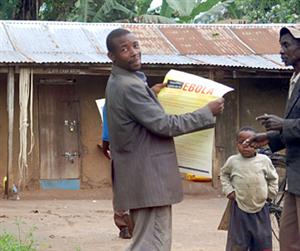 Newsweek magazine has weighed in on the escalating/deteriorating situation in Uganda. And if you read the article carefully, and match Newsweek's suspected case total with the official records, you get a wildly divergent -- and extremely unsettling -- new number of potentially infected persons. Not to mention the possibility of a deliberate cover-up of the virus by government officials.
The article itself is a good digest of what has already happened. And as we know and is proven by the presence of a reporter in the village -- Newsweek's Andrew Ehrenkranz (photo) -- there is no substitute for Journalist Boots on the Ground. As admirable a job as as the Myhres' have done to update their blog, they are not journalists, aimed at extracting the truth.
The paragraph in question is this one:
Some Ugandans, however, are questioning whether Museveni's government deliberately covered up news of the outbreak ahead of the recent meeting of the Commonwealth Heads of Government meeting in the capital city, Kampala. The government did not announce the outbreak until just after the conclusion of the high-profile meeting, even though government reports acknowledge that blood samples from infected patients were sent to South Africa for Ebola testing on Sept. 29. These samples were reportedly found negative for Ebola but were subsequently shown to carry a new strain of the virus at the Centers for Disease Control (CDC) in Atlanta on Nov. 24—the second day of the Commonwealth meeting. The initial false negative may have been due to the difficulties of identifying the new strain—even the CDC tests took a day longer than usual—but that hasn't stopped public outrage over whether the government could have acted faster to stop the spread of the virus. "It looks quite strange, from a public health perspective, that blood samples were not taken [to the CDC] earlier," said Dr. George Pariyo, dean of the public health school at Kampala's well-respected Makerere University in a front-page Uganda Monitor feature investigating the suggestions of a government cover-up.
Other news regarding the actual number of infected, plus the prospect of large numbers of "super-spreaders" of the disease, are also mentioned by Newsweek:
Bundibugyo is at the epicenter of the outbreak, which began in August. Doctors in the town are monitoring more than 360 sick people believed to be incubating the virus and have recorded 18 local fatalities, including four medical staffers at Bundibugyo Hospital. Townspeople are terrified by the outbreak. Bundibugyo's usually bustling central market is quiet, and residents of nearby villages are anxiously reading newly distributed Ebola information posters. Hawkers sell the antibiotic Cipro at inflated prices on the street, falsely promising that it can prevent infection; local healers and herbalists are offering their own versions of a cure. (bold mine)
The piece continues:
But while the new strain seems to be less virulent, it also raises the possibility that the infected are now more likely to survive long enough to spread it elsewhere. Already there have been Ebola cases in eight districts across Uganda, with confirmed cases as far away as Mbale, a village some 600 miles from the outbreak zone. On Uganda's borders, neighboring Kenya, Rwanda, Tanzania, and Sudan are screening all Ugandans for symptoms and travel patterns in an attempt to halt the disease from spreading into their countries.
Let's hope the global media keeps its focus on this growing problem in Eastern Africa. The entire story can be found at: