
Entries in Politics and government (199)
So why was 2007 milder than 2006 for H5N1?
 Scott McPherson
in Politics and government, influenza and infectious diseases
|
Scott McPherson
in Politics and government, influenza and infectious diseases
|
 2 Comments
The post-mortem (forgive the expression) for H5N1 around the world in 2007 shows, by any yardstick, an improved situation. There were fewer reported human cases; fewer nations experienced the disease; and fewer human deaths.
Poultry, however, did not fare so well. The numbers of poultry culled were in the tens of millions of birds. There may be no real way to measure how many ducks, geese, swans, turkeys and chickens gave their lives for the eradication of H5N1. Well, most of them were going to give their lives sooner or later, anyway. Some 600,000 birds were culled in Russia in one week in late 2007.

"Mr. President, the roosters of America are prepared to do their duty!"
The economic impact of H5N1 was especially felt hard in Britain this year. Roughly two hundred thousand British turkeys, geese and chickens in total were culled in February, November and December of 2007. Holiday fowl had to be imported from as far away as Brazil. And Britons were shelling out as much as $200 for a holiday bird!
Britons Buy $200 Turkeys as Bird Flu Shrinks Christmas Supplies
By Brian Lysaght
Dec. 19 (Bloomberg) -- The 1,800 turkeys on Sheepdrove Farm in Britain's Berkshire Downs spent the summer and autumn feasting on grubs and wheat and roaming through meadows.
This month, these Norfolk Bronze birds with dark plumes and scarlet beaks were being slaughtered, hand-plucked and hung for 14 days on the 2,500-acre organic farm 60 miles west of London. It's the end of their rural idyll and the first step toward a hallowed British holiday tradition -- Christmas Day lunch.
Organic farms such as Sheepdrove are flourishing after one of the toughest-ever years for Britain's poultry industry. Nearly 200,000 birds were culled after outbreaks of a deadly form of bird flu and feed prices surged on higher wheat costs. That's pushed up holiday bird prices by as much as 38 percent and increased demand for organic turkeys, which cost as much as 100 pounds ($205).
Although Sheepdrove Farm stopped taking orders on Dec. 10, ``we've had about 100 calls since we sold out,'' said Michael Benson, the farm sales manager. He plans to raise 2,500 turkeys next year.
Sales of organic turkeys, which must be free ranging and raised on additive-free feed, will jump 46 percent this year, the British Retail Consortium predicts. That compares with a 7 percent increase the industry group forecasts for total turkey sales.
Consumers say the organic birds are safer and tastier.
Helen Day, a 36-year-old administrative assistant in London, said she'll splash out on a free-range turkey for Christmas. ``The flavor's better, and it's worth the money,'' she said.
A Better Bird
Richard Corrigan, chef at the Michelin-starred Lindsay House restaurant in central London, isn't balking at paying 15 percent more this year for organic birds to be served in his festive turkey salads as part of the restaurant's 55 pound tasting menu.
``The food I put in my mouth has to have lived a certain life,'' Corrigan said. ``Who wants to have hundreds and hundreds of birds in a shed?''
England had its first outbreak of the deadly H5N1 strain of bird flu last February at a turkey farm operated by Bernard Matthews Holdings Ltd., Europe's largest factory poultry producer. More than 150,000 turkeys were killed to control the virus.
In November, another outbreak forced the slaughter of 15,500 turkeys, ducks and geese on two farms in Suffolk, eastern England. That may have been caused by wild birds mixing with free-range farm poultry, the U.K. government said in a report on Nov. 29.
Waitrose Ban
Premium supermarket chain Waitrose said Dec. 7 it won't stock organic Christmas turkeys this year because the farms where the disease was found, Redgrave Park Farm and Hill Meadow Farm in Suffolk, were suppliers.
The cancellation will probably further boost independent organic farmers, according to Anna Bassett, a poultry specialist with Britain's Soil Association. The group advises farmers about organic methods, which include rules about crop rotation, natural fertilizer and additive-free animal feeds.
In addition to the aftermath of the bird-flu outbreaks, farmers also face higher feed prices because of rising commodity costs. Wheat traded in Chicago rose above $10 a bushel for the first time on Dec. 17. The grain's price has more than doubled in the last year as drought reduced output from Canada to Australia.
Tom Copas, who raised 50,000 free-range and organic birds at his farm in Cookham, England, boosted his prices by 10 percent. A medium-size organic Copas turkey is 13 pounds a kilo (2.2 pounds) with free-range, non-organic birds costing 9 pounds a kilo.
American Import
``Orders are coming in very well,'' said Copas, whose family has raised turkeys for 50 years and said most of the birds have been sold.
Turkeys first arrived in Britain in 1526, brought by Yorkshireman William Strickland, who acquired six birds from American Indian traders, according to the British Turkey Association. The tradition of eating turkey at Christmas dates from the 19th century, when it began to replace goose and more exotic fare such as swan and peacock. Last year, Britons bought 10 million Christmas turkeys.
Wholesale prices for turkeys have risen as much as 38 percent, according to a Nov. 30 survey by the U.K. government. Birds of up to 9 kilos are selling for 2.60 pounds a kilo compared with 1.88 pounds a year earlier, the survey said.
Last year, retail sales of organic products in the U.K. rose 22 percent to 1.94 billion pounds, the Soil Association said. The country's market for organic goods has grown 27 percent annually on average over the last decade. It's still a relatively small market, with organic making up 3 percent of all meat, poultry and fish sales, the group estimates.
Farmers say they believe the crisis will continue to drive sales.
``Our customers have the money to spend, they want the best for their families and are willing to pay the price,'' said Sheepdrove's Benson.
http://www.bloomberg.com/apps/news?pid=20601085&sid=aohK8JhZoZLo&refer=europe with a hat-tip to Shannon of FluTrackers.
So why was 2007 more moderate for H5N1 than 2006? I would give the following reasons:
Climate. The year 2007 was, on balance, a much milder year than 2006. http://www.hprcc.unl.edu/nebraska/winter-2007-global.html The effects of climate on Influenza A are still not clearly understood, but the rule of thumb has been the milder the winter, the milder the virus.
Surveillance. Surveillance has dramatically improved since 2003. The world is, for the most part, operating solidly when it comes to surveillance. There are far too many surveillance holes for us to become even remotely comfortable, but it is a much more favorable situation than in 2003.
Education. People in remote areas have learned to better handle sick, dying and dead wildfowl, and to practice better hygiene. People are also learning how to fully cook the virus out of their food. Word travels fast, even in remote areas of the planet, when death and disease are concerned.
Payments. Compensation to farmers is becoming more equitable, and farmers are thus more apt to report when their flocks are infected. This is not the rule everywhere, sadly. It needs to become more prevalent.
Culling. While difficult to track all culling operations, indications are that more poultry were culled in 2007 than in 2006. This equates to fewer opportunities for the virus to mutate. Also, culling technology and science is improving, as information and knowledge passes in ones and zeros, in real-time over the Internet.
Fewer nations reported the virus. The FAO reports that 2007 saw initial emergence of H5N1 in five new nations, which is bad. But the number of nations reporting H5N1 in poultry and in humans declined over the same period in 2006. http://www.fao.org/docs/eims/upload//237149/ah693e.pdf
While we all can light cigars and celebrate this collective series of improvements, we also must recognize the flip side:
Indonesia continues to worry us. Sub-Saharan Africa is a powderkeg when it comes to -- well, when it comes to everything, including H5N1. The new cluster cases in Pakistan and Egypt show us the virus is continuing to confound the experts.
And finally, the sobering conclusion from the FAO:
In conclusion, in 2007 there has been an improvement in the general HPAI (H5N1) situation worldwide, but
there is still a risk of recurrence and spread of the infection, and the disease is becoming enzootic in some
regions.
Happy New Year. Keep watching.
On tsunami's third anniversary, an open letter to Indonesia's leaders
Scott McPherson
in Politics and government, influenza and infectious diseases
|
Post a Comment
To the leadership of the nation of Indonesia:
Today, as you know, marks the third anniversary of the terrible tsunami that ravaged your nation of 18,000 islands. The world grieves today, as it did the day after Christmas, 2004. And we continue to grieve at your loss of life, as we grieve today for the deaths due to the mudslides that have hit your nation and killed scores of your citizens.
So long as the human race has any modicum of compassion left in it, the world will rush aid to your people. May we never let you down on that score.
But the world also works on a principle of reciprocity. The ying and the yang, if you will. Quid pro quo. And there is a way the nation of Indonesia can help repay the world for its ongoing compassion.
And that is by showing some compassion back. Simply put: Please share all of your H5N1 human, swine and avian samples with the world community -- beginning today.
You believe you have some sort of stake in the game with your samples. You believe you have some currency. And it is understandable that you would want to try and leverage the little you have on behalf of your people.
However, the world's next pandemic may not start at your door. Your versions of bird flu may not even start the next pandemic. And then again, perhaps your nation is indeed at the eye of the viral typhoon to come. Only God/Allah knows the answer to that question -- and He ain't giving the answer away easily.
There is an army of scientists -- legions of them, on every continent on Earth save Antarctica -- that are prepared to work with you on this issue. These men and women can help decipher the clues to the next mutation that might turn H5N1 into the most efficient, ruthless killer of human life ever seen on this planet.
To withhold this viral information in the hope that you can somehow get into line first among equals is simply not right. Remember that a vaccine is probably eight months away from a pandemic's start, in the best of circumstances. Time and again the world has shown it is ready to fly antivirals into your nation in the hope that the Next Pandemic can be stopped at the rural village level, before it has the chance to mutate and enter your largest cities. And that is where the First Wave will be fought. With antivirals, possibly at your front door. Not with vaccine.
Your contract with America's Baxter Pharmaceuticals is understandable. Your desire to begin injecting your citizens with prepandemic vaccine underscores your nation's obvious and justified preoccupation with this disease. And if indeed the Indonesian strain is the trigger of the next pandemic, I am sure the shots and the royalties from Baxter will be most helpful. As you also know, H5N1 is a mutating wonder. What guarantees are there that any prepandemic vaccine will even work? Even if Baxter's formula does work, I do not believe Baxter alone will not be able to manufacture enough vaccine for your entire nation. Sooner or later, you will be calling upon the collective manufacturing capability of the rest of the world to help you. And the perception that Indonesia may be putting profits ahead of lives creates global enemies that your nation cannot (literally) afford to have.
Also heed the lessons of 1976 and Swine Flu H1N1. Read the history of that debacle before you store vaccine "in people, not in warehouses." Learn from the mistakes the US made in 1976 and 1977.
Above all, practice proper diplomacy. The world has a long memory. If indeed the next pandemic comes from an Indonesian strain, and your government was withholding the strain's viral molecular information in order to obtain financial and/or vaccine guarantees, and the world determines that Indonesia could have saved countless millions of lives by sharing virus samples now and deliberately chose not to: Know that the world's compassion has limits.
Choose wisely..
WHO: Limited Human Transmission of Bird Flu in Pakistan
Scott McPherson
in Politics and government, influenza and infectious diseases
|
1 Comment
 The following is straight from the Voice of America Website. My comment is at the very bottom of this blog.
In the photo at left, the AP caption reads: Hospital staff clean and disinfect room in isolation ward where bird flu patient was treated in Abbotabad, Pakistan, 17 Dec 2007
| WHO: Limited Human Transmission of Bird Flu in Pakistan |
| 21 December 2007 |
WHO's top bird flu official David Heymann Friday, said there appears to be no threat of the further spread of the H5N1 virus, with the last human case reported December 6.
At least eight people were infected in Pakistan's northwest in recent weeks - in the country's first human cases of bird flu.
One man who worked on poultry farm in North West Frontier Province has died. His brother also died recently, but was not tested for the virus.
Heymann says the cases appear to be part of a small chain of human-to-human transmission.
A WHO team is investigating the outbreak and results from initial laboratory tests are expected in the next few days.
Pakistan's Health Ministry began sending out messages Thursday, asking people to take proper care when slaughtering and handling chickens.
Earlier this week, a WHO team visited a hospital in the northern city of Peshawar to educate doctors on controlling the spread of bird flu.
WHO says more than 200 people have died of bird flu worldwide since 2003.
Some information for this report was provided by AP and Reuters.
http://www.voanews.com/english/2007-12-21-voa50.cfm
So the WHO confirms limited H2H in the Pakistani cluster. So we were right. And notice how there is the distinct absence of surprise to this disclosure from the WHO. I think it was Mike Coston who points out this lack of emotion in today's blog over at Avian Flu Diary. Point well-taken. Add this to the list of other H2H episodes that have taken place around the world.
It is also time for Dr. Anthony Fauci to update his Powerpoint presentation. The following two images are taken directly from a Powerpoint presented by Fauci, who is well-known in flu circles as the director of the national Institute of Allergy and Infectious Diseases, at the National Institutes of health, an arm of the United States Department of Health and Human Services. The presentation was found on the Internet and is public record.
Dr. Fauci does not shy away from bringing up the topic of human-to-human transmission of H5N1 avian influenza. In fact, he dedicates at least two key slides to the debate. Here they are, and they are pretty self-explanatory:


When I am trying to make the case to move to Phase Four, it is not merely because limited human-to-human transmission has occurred multiple times. It is because the suspected H2H transmission is becoming more and more common. It is also because we do not know when Tamiflu may mask the presence, or prior presence, of H5N1 in people, and we also do not know if the authorities are being completely transparent and conducting all possible tests to make sure the issue is closed.
People closely connected with H5N1 in humans will speculate quietly that, of all the clusters that have appeared since 2003, the Turkish cluster (noticeably absent from Dr. Fauci's slide) was the most probable H2H2H we have known of. But since scientific access was so tightly restricted by the Turkish government, we will never know for sure if a Phase Four virus emerged from that cluster. I say "since 2003," because everyone pretty much feels like the 1997 debut of human H5N1 was a big, big event and was the single biggest pandemic threat since 1976.
Anyone need a refresher on Turkey?
http://news.bbc.co.uk/2/hi/europe/4594488.stm
http://www.iht.com/articles/2006/01/05/news/flu.php
http://www.iht.com/articles/2006/01/06/news/flu.php
http://www.medicalnewstoday.com/articles/35875.php
The suspected Turkish cluster occurred in January 2006. The Sumatra cluster (diagramed above) happened in May, 2006. The Pakistani cluster happened this month. And as Dr. Fauci points out, there have been numerous other times where H2H2H cannot be proven.
But it cannot be disproven, either. And the empirical evidence points to H2H2H. So does the expenditure and mass distribution of impressive quantities of Tamiflu. Actions speak louder than words, WHO. So may we agree that whenever more than a few courses of Tamiflu are distributed -- let's say, when Tamiflu is delivered to more than 2,000 people within four remote Indonesian villages (August 2006) or an entire island off the coast of Sumatra (October 2007) or used on Pakistani villagers (December 2007), or used on an Indonesian town (December 2007), this just might constitute prima facia evidence of increased human-to-human transmission?
Or is it just being careful?
Will H2N3 reassortant prove Maurice Hilleman correct?
Scott McPherson
in Politics and government, influenza and infectious diseases
|
1 Comment
 There are two apparently conflicting schools of thought, when it comes to predicting which strain of influenza will eventually "go pandemic." The first school believes that a novel strain -- usually, as we all believe, H5N1 -- will be the one to eventually explode.
But the second school rarely gets attention. That school believes that pandemic viruses recycle themselves and reappear every so often. There is not a lot of information available Out There on that subject, but one of its strongest proponents was the late scientist, Dr. Maurice Hilleman.
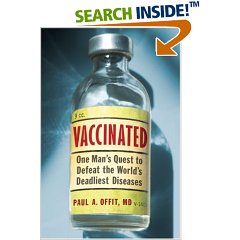
Hilleman's name should be a household word by now, but the man was not into that sort of thing. I offer you, verbatim, and from Amazon.com, the Booklist starred review of Dr. Paul Offit's superb work Vaccinated: One Man's Quest to Defeat the World's Deadliest Diseases.
From Booklist
*Starred Review* Maurice Hilleman's name isn't well known, and according to infectious disease expert Offit's riveting biography, that is both a shame and a blessing. It's a shame because the outspoken, brilliant, yet humble scientist from Montana invented vaccines that all but wiped out a number of infectious diseases. Thanks to his genius, such diseases as mumps, rubella, measles, and hepatitis A and B no longer claim millions of lives, mostly children's. He merits greater recognition. His obscurity is a blessing because it prevents more people from using his name in vain, for Hilleman's vaccines have recently become increasingly controversial and their efficacy clouded by questions about adverse side effects. Still, Offit pulls no punches in defending Hilleman against those who would crucify him for combining measles, mumps, and rubella vaccines into one shot and for the choice to add thimerosal to extend the shelf life of all vaccines. Despite the fact that Offit's bias on behalf of public health shows, the book is a powerful examination of the kind of single-minded determination it takes to tackle diseases that threaten the world's children. And to do so without bravado—no vaccine bears Hilleman's name, no awards his mantle—is to define what it is to be simply heroic. (Chavez, Donna)
Flu aficionados who are not aware of Hilleman need to look carefully at the work he did in 1957. Offit makes a persuasive case that it was Hilleman who first uncovered the 1957 H2N2 flu pandemic and was the first to develop a vaccine -- in four months! Admittedly, he did this without regard to the Feds, and he took risks. But the results of his work are indisputable. The mortality of 1957's H2N2 was ten percent of the 1918 pandemic. And with astonishingly little available in the literature regarding the 1957 pandemic, any time anyone devotes multiple pages to that event, it is worthwhile reading. And since the book opens with a look back at the 1997 emergence of H5N1, and closes with a prediction of H2N2 as the next Big One, it is also required reading -- if even using the index on a cold Sunday at Borders -- for all who are interested in influenza and infectious diseases.
Before his death, Hilleman said he did not think H5N1 would produce the Next Pandemic. But he believed he had stumbled onto a pattern of viral behavior that may be hard to shake. He believed that pandemic influenza viruses came in 68-year intervals. using this technique, he believed that the 1889 pandemic was an H2 virus. He supported this with testing which (at the time and using 1957 science) purported to show that elderly people who survived the 1889 pandemic possessed antibodies to the H2 substrain. Influenza textbooks have also adopted this view; namely, that 1889 was an H2; 1900, an H3; and so on.
This view is hotly debated in microbiological circles. Some researchers, such as W.R. Dowdle of the Task Force for Child Survival and Development in Decatur, Georgia, believe that an H3, not an H2, was responsible for the 1889 pandemic. Hilleman believed an H3 was responsible for the mini-pandemic of 1900; Dowdle also believes differently.
But not too differently: I quote from the abstract of Dowdle's research paper, H2 variants should be included in pandemic planning for a number of reasons, but not because of evidence of recycling. It is not known when the next pandemic will occur or which of the 15 (or more) haemagglutinin subtypes will be involved. Effective global surveillance remains the key to influenza preparedness.
OK, now on to today's events. A brand new research paper has uncovered a new reassortant hybrid swine/avian H2N3 virus, previously only detected in wild birds. Dr. Richard Webby of legendary St. Jude Childrens Research Hospital in Memphis (home of Dr. Robert Webster), along with researchers at the University of Iowa (where swine influenza was first discovered) and the University of Minnesota (also no slouches at the flu) released a major work. The short form: Pigs can, indeed, be the "Mixing Vessel" to produce a potential pandemic strain.
The bigger news is that H2 is now officially back on the Short List for the Next Pandemic Strain. No doubt this will be welcome news to those who are laboring fruitlessly to persuade/convince their superiors that a flu pandemic is around the corner, if not outright imminent. Anyone under the age of 50 is not immune to H2. Also, no one is immune to the neuraminidase N3. And a swine/avian H2 reassortant may not afford complete immunity to those who lived through 1957, as I did. I recall my fever: I was 2 at the time, and I hallucinated that a train was running up the wall of my bedroom. The memory of that hallucination stays with me today. And no, it was not provoked by the 60s!. Wise guys.
By the way, the H2N3 was not found in Guangdong Province, China.
It was found and typed in Missouri last year, which is ironic, since it is the Show Me state.
Now, do we go back, like the Indonesians and Pakistanis have done, and try to find untyped influenza infections in farms in Missouri that were passed off as seasonal flu, no biggie?
Hmmmmm.
A huge hat-tip to Crof and FLA_MEDIC for breaking this story on H5N1 and Avian Flu Diary.
Shakespeare in Pakistan
Scott McPherson
in Politics and government, Popular Culture, influenza and infectious diseases
|
Post a Comment
 Make yourself comfortable, as this blog is unusually long -- even by my standards
The first World Health Organization team is on the ground and working in Peshawar province in northwest Pakistan. And barely within hours of the arrival of the advance team, declarations were made and assurances were given that things were not as bad as first thought.
But Shakespeare also deplaned in Pakistan, accompanying the WHO team to the microphones. First, the stories on the arrival of the WHO. This is from Pakistani newspaper The News:
| WHO team visits families of bird flu victims |
 |
|
|
| By Mushtaq Yusufzai 12/19/2007 |
PESHAWAR: A team of the World Health Organisation experts on Tuesday visited the NWFP where they visited the Khyber Teaching Hospital and also met the ill-fated family of two young students who died of bird flu virus in October.
Also, a WHO technical team is also arriving Pakistan today (Wednesday) which, according to sources, would verify the results of bird flu victims diagnosed by the NIH Islamabad.
After their arrival, the WHO officials held talks with senior officials of the NWFP health department who told them of the situation in the province created after the bird flu virus.They went to the Khyber Teaching Hospital (KTH) where the two young brothers, Muhammad Idrees and Muhammad Ilyas, died on October 19 and 29 respectively mainly because of sheer negligence of the hospital administration, the NWFP health department as well as of the National Institute of Health (NIH), Islamabad.
In KTH, the WHO team arranged an informative workshop for doctors and nurses of the hospital, especially those dealing with bird flu patients.
Officials in the KTH told 'The News' the WHO team had brought Personal Protection Equipment (PPE) for the staff of the hospital.
The team also visited isolation rooms in the hospital where patients suffering from bird flu virus were admitted and advised the hospital administration to select some safe place at a distance from the rest of the hospital for keeping the bird flu victims, so that the virus could not spread in the hospital. It is very painful to mention here that in the entire province, there is not even a single isolation room for infectious diseases.
With the consultation of the WHO team, the KTH administration selected a separate portion in the hospital for keeping bird flu patients. There are 11 isolation rooms in the portion, which would accommodate 22 patients.
Acting Chief Executive KTH, Prof Dr Siddiqur Rahman, nominated Dr Mukhtiar Zaman Afridi as the head of a team that would handle bird flu related cases.
The WHO officials praised doctors and health workers of the KTH for their efforts, which the officials felt saved many lives. The team members said in the world so far 60 per cent of the bird flu patients died while the ratio in Pakistan, 35 per cent, was quite encouraging.
The team members later went to Tajabad town in Peshawar and met the family members of two young brothers died of the disease.
Note the October reference to the deaths, which we think was actually November 19 and 29, respectively. But everything is up in the air these days, as we try to figure out if a brother is really a cousin, etc. So let's stay loose on relatives, and dates of death for the time being.
Note the October reference to the deaths, which we think was actually November 19 and 29, respectively. But everything is up in the air these days, as we try to figure out if a brother is really a cousin, etc. So let's stay loose on relatives, and dates of death for the time being.Now a second report on the activity in the region, this time from Indian newspaper The Hindu. All bolding is mine.
Experts comb Pak. for signs of human-to-human bird flu infection
ISLAMABAD, Pakistan (AP): A second team of health experts arrived in Pakistan on Wednesday to analyze samples from suspected bird flu cases to determine how the virus spread and whether human-to-human transmission may have occurred.
The experts from the US Naval Medical Research Unit No. 3 were expected to retest samples already gathered from a number of patients who were positive for the H5N1 bird flu virus in initial government analysis. Once the cases are confirmed, work will begin to piece together how the victims became infected.
"They are now investigating," said Orya Maqbool Jan Abbasi, spokesman for Pakistan's Health Ministry. ``The next day or two is very important.''
Four brothers were sickened last month in Abbotabad, north of Islamabad. Two died, one of whom was buried before tests were conducted. The other three tested positive for the virus. Up to six more people were suspected of being infected, including several who were in contact with poultry.
Outbreaks were reported among birds in the area before the human cases. However, Abassi stressed that there have been no new reports of bird flu in poultry or people.
A separate WHO team visited a hospital Tuesday in the northwestern city Peshawar that treated some of the patients. They were working with doctors and nurses on how to handle suspected cases and improve infection control measures.
``They want to go through the records in the hospital for the last month or two to see if there's been any upsurge in respiratory cases that weren't identified as H5N1 but which could actually be,'' said Gregory Hartl, a WHO spokesman in Geneva.
The team will look to see which patients could have been exposed to the virus by infected birds and also whether human-to-human transmission could have occurred.
One of the brothers who survived, Mohammed Ishtiaq, said he was hospitalized with flu symptoms after slaughtering chickens suspected of carrying bird flu without wearing protective clothing last month.
His brothers who died visited him in a hospital, he said.
Hartl said no new cases have been discovered, but increased awareness has led to more people with flu-like symptoms being checked.
``What this is showing is that they're taking everything very, very seriously,'' Hartl said. ``Surveillance has been enhanced, more people are reporting cases and more people have been sensitized on the heath care worker side of the need to notice.''
Pakistan has requested additional supplies of the antiviral Tamiflu as a precaution, Hartl said.
At least 209 people have died worldwide from the virus, which began plaguing Asian poultry stocks in late 2003, according to the WHO. It remains hard for people to catch, but scientists worry it could mutate into a form that spreads easily among people, potentially sparking a pandemic.
Associated Press medical writer, Margie Mason, contributed to this report from Hanoi, Vietnam.
But wait, according to WHO influenza head Dr. Keiji Fukuda, there is nothing extraordinary going on in Pakistan. This story is from Reuters, dateline Islamabad (as was the above AP story), so we know for sure we have Mainstream Journalist Boots On the Ground! I am bolding all Fukuda quotes and references.
WHO probes Pakistan's first bird flu death
By Augustine AnthonyTue Dec 18, 2:25 PM ET
Pakistani authorities and World Health Organisation experts were trying to determine on Tuesday whether bird flu had passed from human to human after the country reported its first human death from the virus.
But Pakistani and World Health Organisation (WHO) officials said there was no immediate cause for alarm and the United Nations agency was not raising its level of pandemic alert for the time being.
Pakistani health officials confirmed at the weekend that eight people had tested positive for the H5N1 bird flu virus in North West Frontier Province since late October, and one of the confirmed cases had died.
A brother of the dead man, who had not been tested, also died. It was not yet clear if he was a victim of bird flu.
Ministry of Health spokesman Orya Maqbool Jan Abbasi said the first man to catch avian influenza had been working culling poultry. He recovered but his brothers died.
Abbasi and other health officials said there was no suggestion of human to human transmission.
"Absolutely not," said Health Secretary Khushnood Akhtar Lashari. "The WHO is looking into all the things but whatever we have at the moment there's nothing to suggest that, remotely."
 The global coordinator of WHO's influenza program, Keiji Fukuda, also said the eight cases are likely a combination of infections from poultry and limited person to person transmission due to close contact.
Fukuda said while unconfirmed, any human to human spread seemed similar to previous outbreaks in Thailand and Indonesia -- affecting close family members caring for sick loved ones, adding it was very reassuring that "we are not seeing large increases in the number of cases."
"It is definitely possible that we have a mixed scenario where we have poultry to human infection and possible human to human transmission within a family, which is not yet verified," he told Reuters in an interview.
Humans rarely contract H5N1, which is mainly an animal disease. Experts fear the strain could spark a global pandemic and kill millions if it mutates to a form that spreads more easily.
SECOND WHO TEAM
Lashari said the man who had been culling poultry might have inadvertently brought the virus back to his home, where his brothers fell sick.
"He took his equipment along and the suspicion is the virus was in the equipment he was carrying," Lashari said. "These are conjectures. It will be established when they do the sequencing test of the virus."
The area of the outbreak, near the towns of Mansehra and Abbottabad, about 60 km (40 miles) north of the capital, Islamabad, is in the foothills of the Himalayas. Partly forested slopes are dotted with villages and small chicken farms.
Abasi said 100 people with symptoms of flu living in the vicinity had been checked but all tested negative.
The last human case was reported on November 23, he said.
Of the seven people confirmed to be sick with avian influenza, six had recovered while one was being treated, a provincial health official said.
A three-member WHO team, joined by officials from the Pakistan National Institute of Health, traveled on Monday to Peshawar, the province's capital where the patients were treated. A second WHO team was due to arrive on Wednesday.
Authorities reported the last H5N1 virus case in wild birds in the area on November 30.
Bird flu first appeared in Pakistan in early 2006, and several outbreaks of H5N1 were reported this year.
The Pakistani cases bring to nearly 350 the number of people worldwide who are known to have contracted the H5N1 virus, which has killed more than 200 people since 2003.
(Additional reporting by Robert Birsel in Islamabad and Stephanie Nebehay in Geneva; Editing by Sami Aboudi)
Dr. Fukuda is a very well-respected doctor. He is also with the WHO/UN, which means he is also a diplomat. So parsing words is a unique talent; so is deciphering them. Another Fukuda reference comes today from Reuters:
Mixed scenario seen behind Pakistan birdflu spread
By Stephanie NebehayTue Dec 18, 5:29 PM ET
The eight individuals in Pakistan who are suspected to have bird flu probably have a combination of infections from poultry and limited person-to-person transmission from close contact, a top World Health Organization expert said on Tuesday. Keiji Fukuda, coordinator of WHO's global influenza program, said while unconfirmed, any human-to-human spread seemed similar to previous outbreaks in Thailand and Indonesia -- affecting close family members caring for sick loved ones.
There was no immediate cause for alarm and the United Nations agency was not raising its level of pandemic alert for the time being, he said, adding it was very reassuring that "we are not seeing large increases in the number of cases."
"Right now it doesn't look like pure human to human transmission. It looks like the veterinarian, who was the index case, and a number of other suspect cases had poultry exposure," Fukuda told Reuters in an interview.
"It is definitely possible that we have a mixed scenario where we have poultry to human infection and possible human to human transmission within a family, which is not yet verified."
But human to human transmission "would not be particularly surprising or unprecedented," he added.
Eight people have tested positive for the H5N1 bird flu virus in North West Frontier Province since late October, and one of the confirmed cases has died. A brother of the dead man also died, but was never tested, so is not counted among them.
H5N1 is mainly an animal disease, but experts fear it could mutate into a form that could spread easily between people, causing a pandemic which could kill millions of people. In Thailand, a mother was killed by the virus in 2004 after cradling her dying infected daughter all night. The largest known cluster of human bird flu cases worldwide occurred in May 2006 in Indonesia's North Sumatra province, where as many as seven people in an extended family died.
Three WHO experts, led by Hassan El-Bushra of its regional Cairo office, is in Pakistan helping to investigate the outbreak.
The "index" case, who recovered, is a veterinarian who helped with culling operations and it is his two brothers who died after taking care of the ill man, according to Fukuda.
"This type of close contact we know can result in human to human transmission sometimes," he said.
"Right now, based on the information we have, the investigation going on and the feedback from the field team, we don't have anything pointing to push the alarm bells or increase the (pandemic alert) phase," he added.
The WHO uses a series of six phases of pandemic alert to gauge the level of threat. The world is currently in phase 3, a new influenza virus subtype is causing disease in humans, but is not yet spreading efficiently or sustainable among humans.
"In terms of public health implications, we are looking for human to human transmission where casual contact can lead to infections and allow big outbreaks in communities," Fukuda said.
A team from the U.S. Naval Medical Research Unit NAMRU-3 laboratory in Cairo was expected in Pakistan on Wednesday to carry out further tests on the samples from the suspect cases.
Gee, wonder where he got that "pushing the button" reference? Or the need to reassure the planet that this is no reason to go to Phase Four?
There are three possible reasons:
1. Dr. Fukuda reads this blog. Highly unlikely.
2. The mainstream media reads this blog, along with other blogs and Flusites such as FluTrackers and Flu Wiki. They decided to probe the question of Phase Four based on reading blogs and flusites. Or the media Googled the beejeesus out of the issue and found all the references. Possible, even likely.
3. The WHO is "leaning forward" on the issue of when to actually raise the threat level, and Dr. Fukuda was speaking what everyone in Geneva was thinking. In other words, Dr. Fukuda, Dr. Margaret Chan and global influenza experts were thinking the exact same thing we were: Is this the appropriate time to Push The Button?
This is the Most Likely Scenario, in my opinion.
I want to zoom in on what Dr. Fukuda said as a guide for when we can expect Phase Four to be enacted. Again, from the news story above:
So, back to the bard. Why did he deplane in Pakistan? The answer is complex yet simple. Pakistan is wrestling with potential civil war, terrorism a la al Qaida and its leader Osama bin Laden (who may or may not be hiding in the same geographic region where all the flu stuff is taking place), huge public demonstrations and percolating civil unrest, and there is always that nuclear thing with India. And as we all know, yesterday in southern Pakistan a train accident killed nearly 50 people.
 So a nation with a shaky government and warring factions and a hostile neighbor and the world's Public Enemy #1 hiding within its borders -- well, they kind of need some good news for a change. Good News would be defined in this context as the absence of really bad news. And as we are seeing in the entire nation right now, there is High Anxiety among its people. What if the WHO actually came out and said sustained H2H happened? It is not inconceivable that Pakistan could reach the Tipping Point. In global terms, that would be a really, really bad thing.
You have probably already guessed the Shakespeare line I am referring to. It is from Hamlet. Hamlet turns to Queen Gertrude and says,
"Madam, how do you like this play?"
Queen Gertrude replies, "The lady protests too much, methinks."
Let's just hope Hamlet's response is from the WHO's mouth to the world's ears: