
Entries in Politics and government (199)
Killing two birds with one stone
 Scott McPherson
in Politics and government, influenza and infectious diseases
|
Scott McPherson
in Politics and government, influenza and infectious diseases
|
 1 Comment
|
1 Comment
|
 1 Reference
The Swedish have stirred up a mild flurry of press coverage with the disclosure that Tamiflu does not break down in conventional wastewater treatment systems. The Bloomberg news story says:
Tamiflu in Urine, Water May Fan Resistant Flu Virus, Study Says
 Oct. 3 (Bloomberg) -- Roche Holding AG's Tamiflu persists in waste water, which may make the drug a less effective weapon in an influenza pandemic, Swedish researchers said.
The medicine's active ingredient, oseltamivir carboxylate, is excreted in the urine and feces of those taking it. Scientists at Sweden's Umea University found the drug isn't removed or degraded in normal sewage treatment, and its presence in waterways may allow flu-carrying birds to ingest it and incubate resistant viruses.
``That this substance is so difficult to break down means that it goes right through sewage treatment and out into surrounding waters,'' said Jerker Fick, a chemist at Umea University and leader of the study, in a statement yesterday distributed by EurekAlert, a Web-based science news service.
The findings add to concern about the availability of effective medicines in the event of a pandemic sparked by bird flu. Strains either resistant or less sensitive to Tamiflu have been linked to the deaths of at least five people in Vietnam and Egypt. A separate study found Tamiflu may be becoming a weaker weapon against the H5N1 avian flu strain in Indonesia, where the virus has killed the most people.
The spread of H5N1 in late 2003 has put the world closer to a flu pandemic than at any time since 1968, when the last of the previous century's three major outbreaks occurred, according to the World Health Organization. The virus has killed 201 of the 329 people it's known to have infected, the Geneva-based agency said yesterday.
Use With Care
``Antiviral medicines such as Tamiflu must be used with care and only when the medical situation justifies it,'' said Bjorn Olsen, professor of infectious diseases at Uppsala University and the University of Kalmar, in the statement. ``Otherwise there is a risk that they will be ineffective when most needed.''
Scientists say waterfowl, including ducks, are the natural hosts of avian flu. These birds often forage for food in water near sewage outlets. It's possible they might encounter oseltamivir in concentrations high enough to develop resistance in the viruses they carry, the Swedish scientists said in their study, which is to be published in the journal PLoS ONE.
``The biggest threat is that resistance will become common among low pathogenic influenza viruses carried by wild ducks,'' Olsen said. These viruses could then recombine with others that make humans sick to create new ones resistant to the drugs currently available, he said.
Excreted Tamiflu
Millions of doses of Tamiflu have been stockpiled by governments and WHO to treat and prevent flu infections caused by a pandemic. WHO recommends that people infected by avian flu who are older than 1 year receive a five-day course of 750 milligrams of the medicine. The same quantity would be needed for a 10-day course aimed at preventing infection, which could be extended for several weeks until there is no further risk.
As much as 80 percent of the Tamiflu taken in each dose is excreted in its active form in urine and feces and the drug could potentially be ``maintained in rivers receiving treated wastewater,'' researchers from the U.K.'s Centre for Ecology and Hydrology said in a January study.
The potential for resistant strains to emerge this way is greatest in Southeast Asia, ``where humans and waterfowl frequently come into close direct or indirect contact, and where significant Tamiflu deployment is envisaged,'' the study's authors said.
They recommended developing methods to minimize the release of the active Tamiflu ingredient into the waste stream, ``such as biological and chemical pre-treatment in toilets, which could eliminate much of the `downstream' risk.''
Adding to the story, from Reuters:
"Use of Tamiflu is low in most countries, but there are some exceptions such as Japan where a third of all influenza patients are treated with Tamiflu," Jerker Fick, a researcher at Umea University who led the study, said in a statement.
From the AFP wire service story:
Scientists led by Jerker Fick, a chemist at Umea University, tested the survivability of the Tamiflu molecule in water drawn from three phases in a typical sewage system.
The first was raw sewage water; the second was water that had been filtered and treated with chemicals; the third was water from "activated sludge," in which microbes are used to digest waste material.
By the way, the photo at the top of this blog entry is from Konanchubu Wastewater Treatment Plant on Lake Biwa in Shiga Prefecture, Japan. According to http://www.sewerhistory.org/articles/whregion/japan_waj01/index.htm , advanced treatment is used to meet environmental standards for the water quality preservation of this and other designated lakes. The source is the best-selling report Making Great Breakthroughs - All about the Sewage Works in Japan (Japan Sewage Works Association: Tokyo, ca. 2002), pp. 1-56. I know, I know, you've read this cover-to-cover, but I had to include it anyway.
Okay, add Tamiflu to the list of medications you should never dump down the toilet. As we know, environmentalists have been pleading with consumers for years not to dump expired medicine down the crapper, because many of these compounds simply do not break down in the treatment process. Scientists hold the practice of flushing old medicine as being at least partially responsible for the rise in drug-resistant germs. Now we know that Tamiflu, like other medications, takes a licking and keeps on ticking.
What this study also did, by proxy, is help confirm a suspicion that we can adapt an old World War II medical trick for use in a pandemic. This is old news, but it bears repeating. During WWII, medics and corpsmen learned that penicillin use could be extended with the addition of a simple drug -- probenecid. Probenecid slows down the kidneys' natural desire to flush substances quickly. The effect is to double the ability of a drug to perform its desired function. The bottom line effect in wartime was to effectively double the available supply of penicillin. What a clever innovation!
Roche itself has experimented with the concept, as outlined by Dr. Michael Greger in his excellent book Bird Flu: A Virus of Our Own Hatching. Quoting from Dr. Greger's Website:
Roche found that probenicid doubled the time that Tamiflu spent circulating in the human bloodstream, effectively halving the dose necessary to treat someone with the flu. Since probenicid is relatively safe, cheap, and plentiful, joint administration could double the number of people treated by current global Tamiflu stores. “This is wonderful,” exclaimed David Fedson, former medical director of French vaccine giant Aventis Pasteur. “It is extremely important for global public health because it implies that the stockpiles now being ordered by more than 40 countries could be extended, perhaps in dramatic fashion.”2495
Of course, Roche probably does not like the idea of halving the necessary stockpile of Tamiflu! That is quite understandable. But by dispensing and co-administering probenecid at the same time as Tamiflu, you could actually double the number of courses of the antiviral overnight. This has got to be communicated to state governments as a way to heavily leverage the available stockpile of Tamiflu in times of pandemic -- or even severe epidemics, such as we saw/are seeing in Australia.
As we all know, the jury is still out on whether or not Tamiflu will be effective against the next pandemic strain of influenza. We also know the only common denominator among H5N1 human survivors is the administration of Tamiflu. So we can at least hope the antiviral will have some modicum of effectiveness, should H5N1 go pandemic. It is the only pharmaceutical arrow we have in the quiver!
A portion of Roche's study of the use of probenecid in 2002 comes from the blogsite Smart Economy, and the story can be found at: http://smarteconomy.typepad.com/smart_economy/2005/11/smart_wartime_t.html . In part, it says:
 Tamiflu, like penicillin, is actively secreted by the kidneys, and that the process is inhibited by probenecid. "Giving the flu drug together with probenecid doubles the time that Tamiflu's active ingredient stays in the blood, doubles its maximum blood concentration, and multiplies 2.5-fold the patient's total exposure to the drug (see graph, and G. Hill et al. Drug Metab. Dispos. 30, 13-19; 2002)"
So the use of probenecid alongside Tamiflu will improve the effectiveness of the capsule by 2.5 times!
Now let's address the issue of the effect of probenecid on the groundwater and wastewater. This abstract is from the Website bionewsonline.com, specifically at: http://www.bionewsonline.com/f/1/bioremediation_a.htm :
Acta Microbiol Pol, 2003, 52(1), 5 - 13
Overuse of high stability antibiotics and its consequences in public and environmental health; Zdziarski P et al.; In this paper the ecological aspects of widespread antibiotic consumption are described . Many practitioners, veterinarians, breeders, farmers and analysts work on the assumption that a antibiotics undergo spontaneous degradation . It is well documented that the indiscriminate use of antibiotics has led to the water contamination, selection and dissemination of antibiotic-resistant organisms, alteration of fragile ecology of the microbial ecosystems . The damages caused by the overuse of antibiotics include hospital, waterborne and foodborne infections by resistant bacteria, enteropathy (irritable bowel syndrome, antibiotic-associated diarrhea etc.), drug hypersensitivity, biosphere alteration, human and animal growth promotion, destruction of fragile interspecific competition in microbial ecosystems etc . The consequences of heavy antibiotic use for public and environmental health are difficult to assess: utilization of antibiotics from the environment and reduction of irrational use is the highest priority issue . This purpose may be accomplished by bioremediation, use of probenecid for antibiotic dosage reduction and by adoption of hospital infections methodology for control resistance in natural ecosystems.
From Wikipedia:
Bioremediation can be defined as any process that uses microorganisms, fungi, green plants or their enzymes to return the environment altered by contaminants to its original condition. Bioremediation may be employed to attack specific soil contaminants, such as degradation of chlorinated hydrocarbons by bacteria. An example of a more general approach is the cleanup of oil spills by the addition of nitrate and/or sulfate fertilisers to facilitate the decomposition of crude oil by indigenous or exogenous bacteria.
But hey, Wikipedia also says bioremediation was invented by Al Gore, so what do they know? Just kidding on that one.
So let's get jiggy and begin stockpiling probenecid. The use of probenecid alongside Tamiflu, accompanied by a scientific study, would also tell us if the increased time in the human body before peeing it out would reduce the amount of Tamiflu to go into the groundwater, lakes and rivers. It may also tell us if the effective increased dosage (2.5 times!) of each pill might beat back the rapid escalation of virus in human lung cells (remember that Tamiflu is a neuraminidase inhibitor).
While we are at it, let's look at Japan and see if, indeed, we can make a correlation between the (over)prescription of Tamiflu, the amount of active Tamiflu found in treated wastewater, and the Tamiflu resistance now seen in 3% of Japanese Influenza B strains. Again, from the AFP story:
The study, published online on Wednesday by the open-access Public Library of Science (PLoS), pointed the finger at Japan.
It quoted figures from Swiss maker Roche, which estimated that in the 2004-5 influenza season, 16 million Japanese fell ill with flu, of whom six million received Tamiflu.
At such dosages, the amount of Tamiflu released into the Japanese environment is roughly equivalent to what is predicted in areas where the drug would be widely used in a pandemic.
Coincidentally, "Japan also has a high rate of emerging resistance to Tamiflu," the paper said. A 2004 study published in The Lancet found that among a small group of infected Japanese children, 18 percent had a mutated form of the virus that made these patients between 300 and 100,000 times more resistant to Tamiflu.
And throw old medicines away: Don't flush!
Jericho Season One DVD now available
Scott McPherson
in Politics and government, Popular Culture, influenza and infectious diseases
|
1 Comment
 After much anticipation, the inaugural season of the heralded post-nuke serial drama Jericho is available on region 1 (NTSC) DVD.
What, you say? You never saw Jericho? Now is your chance to play catch-up -- and you have almost an entire year to do so! Just don't wait until then to buy the boxed set. You can read the backstory on the television show and how its faithful followers brought it back from the dead here: http://www.scottmcpherson.net/journal/2007/7/2/jericho-returns-to-cbs-july-6th.html
Jericho, Kansas is a fictional town near the Colorado border. Quickly it is caught in the crossfire of a terrorist act, as the terrorists detonate an uncertain number of nuclear bombs across America. When the Denver nuke explodes, it plunges Jericho into a post-apocalyptic world of uncertainty, rumors, and forced self-reliance. Where is the government? What is happening in the adjacent towns? Who bombed America? How will they feed all of the townspeople in the winter? How can they prevent lawlessness and chaos? Who can they trust? Who will step up and who will not?
Interspersed within this story are many intriguing subplots, some romantic, some involve deceit, infidelity, intrigue and possible treason, and some involving politics. In other words, something for the entire family! One continuing subplot involves the once-mayor, Johnston Greene, played in Emmy-caliber fashion by Gerald McRaney. Greene has been defeated for re-election, partly because he is so focused on keeping the town together, he did not bother to campaign. He also had a terrible bout with influenza during this critical post-nuke time, and almost died from the virus. Thought I would throw that one in there for all us flubies!
The populist themes of his victorious opponent quickly give way to the grim realization that Greene has what it takes to lead and the new incumbent does not. The new mayor then gives Greene authority to organize and train the Jericho townspeople to defend their territory against interlopers (rogue mercenary types with shadowy, Blackwater-esque tendencies) and, ultimately, against a rival town with a mad leader.
 Which is where the first season ended: With chaos, the fog of war, and the hint of some sort of New American intervention to stop the conflict before it gets any bloodier (see flag at left).
To tell you any more would spoil the surprise! And that surprise is how well the writers scripted, and well the actors played their roles, for this groundbreaking television show. Jericho is a serious television program for anyone who enjoys good apocalyptic fiction, science fiction, or survivalist fiction. Anyone in a post-9/11 world who speculates on what life would be like if "The Terrorists Win" should view this program. Anyone who ever read Pat Frank's classic novel "Alas, Babylon" will flock to this show like crazy. This show is also required viewing for anyone with a passion for emergency management and disaster preparedness. In fact, one of the featurettes in the boxed set is titled "What If?" The featurette speculates on America's current ability (or lack thereof) to withstand and survive man-made or natural catastrophes.
 OK, here's the deal. After bringing the show back from the dead (again read my earlier blog on how an Internet campaign brought back the show), CBS ordered up seven new episodes for the Summer of 2008. CBS also threw down the gauntlet and said, "Show us the fan base is out there." And CBS will order up more episodes, if they see boxed set sales doing well. So this is your chance to view the phenomenon firsthand, and help bring back a show that we all can take notes from.
Pandemic Planning: Why the wrong "All Hazards Approach" will fail miserably
Scott McPherson
in Information technology, Politics and government, influenza and infectious diseases
|
1 Comment
|
2 References
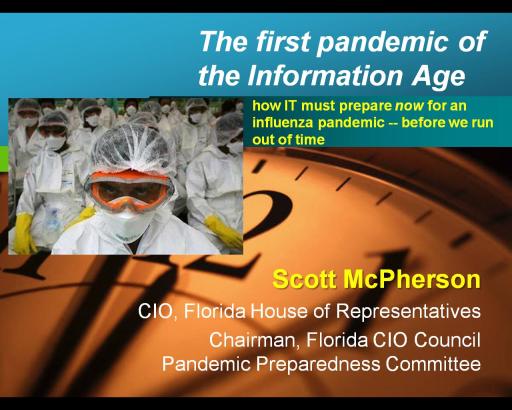 I spend a considerable amount of my "free time" lecturing on avian flu and pandemic preparedness, especially when it comes to information technology. Those are my twin specialties: I am a Chief Information (technology) Officer by profession, and I also have considerable experience in developing massive disaster recovery and business continuity plans (many of you know I developed and ran the largest State government Y2K project in the nation, Gov. Jeb Bush's statewide Y2K preparedness and awareness effort).
So this morning, as I scanned Crawford Kilian's Blogsite http://crofsblogs.typepad.com/h5n1/ , I was directed to an IT story that, quite frankly, doesn't surprise me at all. Today's Computerworld blog title pretty much sums it up:
Pandemic disaster planning: We give ourselves a grade of C-minus, and that's generous.
The blog can be found at http://www.computerworld.com/blogs/node/6214 , and it should concern everyone who reads it. Disaster recovery firm Sungard underwrote the cost of the survey of IT leaders, which was conducted by IDG Research and is published by CIO and CSO (that's Chief Security Officer) magazines. Sungard is taking a strong interest in pandemic planning, if for no other reason than they understand that data centers may fail for lack of trained personnel, and frustrated executives may reluctantly order the implementation of an organization's IT disaster recovery plan just to keep the ol' mainframes and server clusters hummin'. I recently sat through such a Sungard presentation and it was quite refreshing to hear someone other than me talk about IT failures during pandemics.
OK, the short form is that most business and government CIOs are aware of the threat of avian flu, but their own pandemic planning efforts -- and those of their bosses -- are woefully lacking. Nothing new there: We all know pandemic planning lags far behind other disasters.
My latest Powerpoint presentation (which can be found and downloaded at http://bpr.state.fl.us/pandemic/ is titled The First Pandemic of the Information Age deliberately, and with good reason. We have never had a pandemic in the 21st Century, and we dodged a huge bullet with SARS (and its extremely scary 10% Case Fatality Rate). We have no idea how IT will operate in the wake of 20%+ absenteeism and in the era of the Just-in-time economy. But we all know that no entity can operate without IT. It might as well try to conduct its operations by gaslight. IT is the fuel that drives the modern economy, the modern government, the modern everything. That is one major reason I strongly advocate government data center people being classified as "second responders" for purposes of antivirals. Without IT, governments will lose their ability to effectively serve their citizens within 24 hours. That is because in a pandemic, after medical help, citizens will demand sustenance. The assistance will come in the form of checks, drafts, and warrants, usually via direct deposit. The era of people with green eyeshades, writing checks manually, does not exist anymore. And to move that money requires data centers, with mainframes and server clusters working overtime to produce the ones and zeros necessary to convert digital cash into real cash. Try to do THAT in the midst of a major pandemic.
Katrina showed us what happens when government cannot complete its most essential tasks in the most urgent time frame. Imagine what will happen if/when governments fail to take care of their citizens' most basic needs. Those needs include unemployment compensation; aid to families with dependant children; emergency food stamps (although whether or not there will be food to buy in a JIT-failed supply chain is debatable); and housing subsistence. Without those direct deposits/swipe cards/ checks, people will invariably resort to other, more drastic measures to survive.
Which brings us to the source of the title of today's blog. According to Computerworld and IDG,
Among those respondents with plans in place, most organizations plan to allow employees to work from home (76%) and/or will use their current business continuity/disaster recovery plans (72%), while 38% will geographically disperse their operation and personnel and 13% will outsource operations.
Has anyone bothered to ask Sungard or any of the Alphabet Soup Gang (IBM, KPMG, et al) if they have bought Tamiflu for their data center and network employees? What is their strategy for a pandemic? Just because they are selling pandemic services does not mean that they, too, will be ready. So ask them!
Here in sunny Florida, we constantly hear about taking an "All Hazards Approach" to disaster recovery planning. It is preached to us day in and day out. But until I am convinced otherwise, neither Florida, nor any other state with a similar mantra, is prepared for a pandemic. The reason is simple: taking an "all hazards approach" should mean planning for a pandemic as the human equivalent of a 9.0 earthquake or a major terrorist attack or an ice storm of long duration or a Category 5 hurricane. And unless the planning bookends a pandemic as the twin of the "other" Worst Case Scenario, the planning is fatally flawed. Thinking you can manage a pandemic the same way you can manage a hurricane's aftermath is both arrogant and wrong. Pandemic planning and earthquake/hurricane/tornado/terrorist planning should be the twin bookends of disaster and business contunuity planning. Pandemics should not be something you throw into the mix the same way you throw that extra piece of laundry into the washer.
Yet that is exactly what people are doing when they say they will manage a pandemic using their existing DR plans. Because they never planned for a pandemic in the first place, they think they can somehow try to look up "Supply chain failures" on Tab Three of their DR plan and have a solution. Sadly mistaken, they will realize that plan called for massive reinforcements of goods and services from areas outside the affected zones. There will be no mutual aid, no assistance pouring in from the outside world. Government cannot stockpile what it needs, let alone what the population will need.
Also, current disaster recovery and business continuity plans have an event horizon of a few days to a few weeks. There is a conclusion to all these plans. But with a pandemic, the event horizon will stretch for three months. The event will not have a tidy conclusion; it will consist of sporadic, then massive influenza cases, coupled with equivalent sporadic-then-widespread supply chain failures, topped by failures in government's ability to cut checks and serve its people, capped with severe shortages of food and water.
Gradually, as the first wave passes over the nation, people recover and go back to work, and slowly life returns to normal. But unless all disaster recovery and business continuity plans embrace pandemic as the bookend of human suffering and hurricanes and earthquakes as the other bookend, the management of the event will fail. The trucks full of ice will stop. The trucks full of food and medical supplies will run out. And patience with government as a relevant entity will also have run its final course.
The appropriate question to ask governments and businesses is this: "Have you embraced pandemic planning as the human equivalent of your hurricane, ice storm, terrorist and earthquake planning, with the same zeal and gusto and with the same allocation of resources, training and practice?"
If the answer is "No," or worse yet if you get no answer, then their plans will fail miserably. I guarantee it, sadly.
A problem of Olympic proportions
Scott McPherson
in Politics and government, Popular Culture, influenza and infectious diseases
|
Post a Comment
 China has a major problem looming on its horizon, and it is found at the intersection of the 2008 Summer Olympics and H5N1. Simply put, the Chinese know that any ill-timed outbreak of H5N1 in poultry -- coupled with any simultaneous human infections, particularly tourists and/or athletes -- could irreparably harm the nation's economy if it occurs during the run-up to the games, or, even worse, during the Games themselves.
H5N1 junkies may recall the outbreak of bird flu in poultry in northern China's Shanxi Province last summer. The outbreak -- almost certainly Clade 2.3, a.k.a. "Fujian" H5N1 -- happened in the center of a conglomerate of seven busy historic tourist centers. This accompanied a human case in fabled Guangdong Province, in south China near Hong Kong. The Chinese moved with great swiftness to put down the outbreak.
 All this activity set off what I call the Chinese government's "FDI Meter," FDI being the initials for Foreign Direct Investment. The Chinese learned from the SARS epidemic in 2003 that to deceive the world had disastrous economic consequences for the emerging economic power. As chronicled in Karl Greenfield's excellent SARS history China Syndrome (required reading for all influenza aficionados), China lost tens of billions of dollars virtually overnight. There were a number of very brave (braver than any of us, I assure you) Chinese doctors and political dissidents who dared leak the presence of a new and deadly virus to the world. Once the FDI exodus had begun, brand-new Chinese leader Hu Jintao had all the ammunition he needed to open up the nation's dialogue and also use SARS as the method of eliminating his predecessor Jiang Zemin's corrupt and old-line Party leaders, who were ultimately responsible for what I call Mayor Larry Vaughn Syndrome (Murray Hamilton's role in Jaws). Hu's ability to both open up his nation's true situation and simultaneously remove his potential political opposition was the first glimpse at his capabilities and ingenuity. Hu ain't no dummy.
So the CINO Chinese (Communist In Name Only) know, from previous experience, that the presence of a fatal disease, coupled with a clamp-down of media, spells economic TROUBLE.
Let's fast-forward to today's disclosure that in Guangdong Province, the Chinese are taking absolutely no chances. From the People's Daily Online:
150,000 Poultries Culled in Guangzhou Bird Flu Outbreak China's southern city of Guangzhou has destroyed 153,320 domestic fowls in the wake of an outbreak of bird flu, local authorities said on Tuesday. The extermination of 134,384 ducks, 18,786 chickens and 150 doves was carried out in nine villages within a radius of three kilometers from the site of the outbreak, an official with the Panyu district government said. A total of 68 poultry farmers in Panyu district who have had close contact with ducks killed by bird flu have taken blood tests and medical checkups, and were found to be in good condition. The Ministry of Agriculture and the National Avian Influenza Reference Laboratory have confirmed a subtype H5N1 bird flu strain killed 9,830 ducks raised in Sixian Village of Panyu District in Guangzhou City since September 5. The Panyu district government announced on Tuesday the suspension of all poultry markets within a 13-kilometer-radius surveillance zone. Tan Yinghua, Party chief of the district, told Xinhua the district would put more pork, beef and fish on the market to meet the needs of local consumers. As the world's largest producer of poultry, livestock and aquatic products, China has suffered huge economic losses from outbreaks of animal diseases. It is estimated that animal diseases cost China 40 billion yuan annually The previous reported case of H5N1 bird flu in China occurred in May in central China's Hunan Province, which killed more than 11,000 poultry with another 52,800 birds being culled. China has reported 25 human cases of bird flu since 2003, which have resulted in 16 deaths. (Xinhua News Agency September 19, 2007) |
http://english.people.com.cn/90001/90782/6265756.html
With 323 days to go before the Opening Ceremonies, expect more of these quick responses in the run-up to the 2008 Summer Olympics. And isn't it telling that you can get better avian flu information from a Communist Chinese press service than from 99% of the American news media? Maybe if OJ caught bird flu.... that would solve many problems!
Scott McPherson
Scanning Crawford Kilian's excellent blogsite H5N1 this afternoon, I noticed a post with a Washington Post link that we all should read. I did say the Chinese would act quickly; yet they always seem to want to default to the Great Wall Syndrome, namely not telling everyone the truth about what is going on. But in this day and age, the truth will always come out. Just not as rapidly as we would like, perhaps. The blog commentary is at:
http://crofsblogs.typepad.com/h5n1/ and the Washington Post story is at:
http://www.washingtonpost.com/wp-dyn/content/article/2007/09/18/AR2007091801445.html
Letter to Jakarta Post from Bali resident (from Effect Measure)
Scott McPherson
in Politics and government, influenza and infectious diseases
|
Post a Comment
 A blog or two ago, I mentioned that the people of Indonesia would tire of incessant government denials, lies and subterfuge in the battle against H5N1 avian influenza.
A letter writer in the Jakarta Post gives a chronicle of the frustrations Bali islanders must be feeling right now regarding their island paradise's descent into Bird Flu Hell.
First, veteran blogger FLA_MEDIC has reported that another Bali child is sick and in hospital with symptoms of bird flu. His post can be found here. http://afludiary.blogspot.com/2007/08/new-suspect-case-in-bali.html
Now the excellent public health blogsite and forum Effect Measure, recently affiliated with ScienceBlogs.com, has revealed an unbelievable letter from a resident of Bali. The blog and letter can be found here. http://scienceblogs.com/effectmeasure/2007/08/bird_flu_in_indonesia_these_ne.php
In a nutshell, Giuseppe Verdacchi, a resident of the capital city (!) of Denpasar, reports to the Post about his frustrating inability to get any government official on Bali to help him dispose of a dead wild bird he found on his property. particularly enlightening is the admonishment of his village leader. Quoting from the blog/letter:
I tried then to contact the head of my village (in the Kerobokan area) and his reaction was: "Just bury the bird, there is no problem." How would he know?
As the "Reveres" of Effect Measure so eloquently and accurately point out:
Mind you, this is the country with more cases and more bird flu deaths than any other country in the world. The island of Bali, a major tourist area, has had two recent deaths from bird flu. The Indonesian authorities have been vocal and self-righteous about other countries profiting from influenza virus sequence information and viral isolates obtained from cases within their borders and for this reason do not consistently share this information with the world scientific community. Yet at the same time, through negligence, corruption and incompetence Indonesian authorities allow a continuous breeding ground for a virus that threatens everyone on the globe.
With the hospitalization of today's patient, the list of suspected H5N1 cases in Bali grows to 12. Five have been sent home with negative test results; four are dead, and we are awaiting results of tests on the last death; and three remain hospitalized, awaiting test results. And with the exception of the index case and her mother, the remaining cases are all within 20 km of the capital city.